
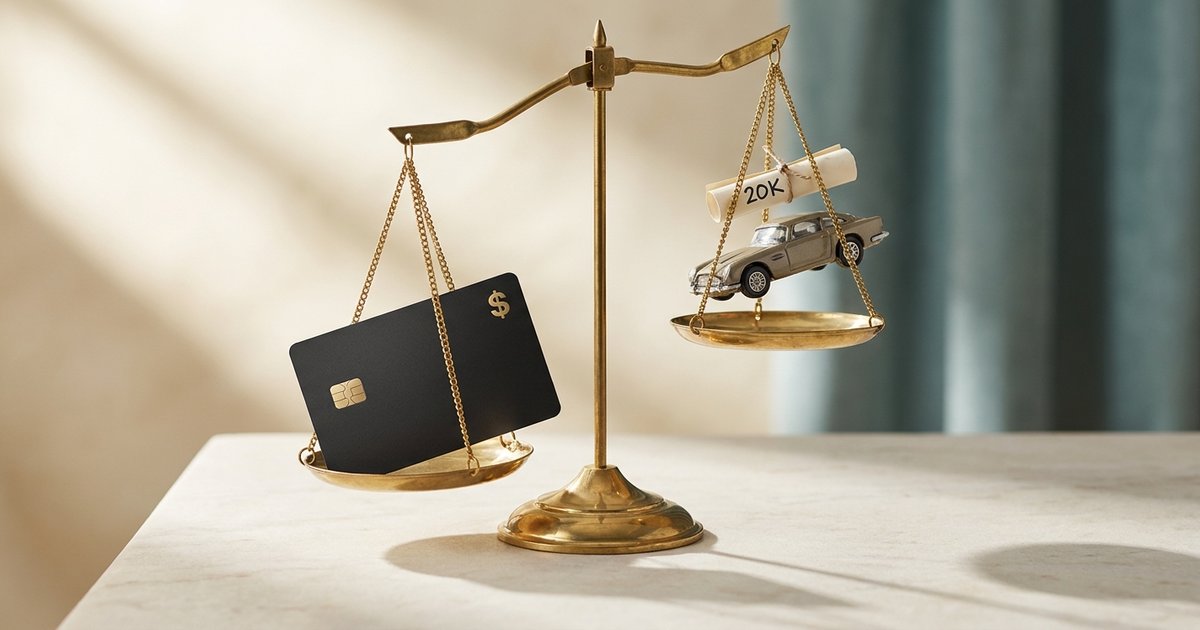
Quick answer: FICO scores revolving credit (cards) and installment credit (loans) very differently. A $500 balance on a $1,000 credit-card limit is 50% utilization, which is heavily punished. A $20,000 balance on a $25,000 car loan is a healthy installment account doing exactly what it should: shrinking. The same dollar amount can move your score 30 to 50 points if it sits on a card and almost zero if it sits on an installment loan.
Picture two people. The first has a credit card with a $1,000 limit and a $500 balance sitting on it. That's it. No other debt. The second person just financed a $25,000 car and owes $20,000 on the loan. Same person otherwise: same income, same payment history, same age of credit.
Whose credit score is worse?
If you said the person with the car loan, that's the intuitive answer, and it's wrong. The person with the $500 card balance is almost certainly carrying a lower score, often by 30 or 40 points. I know that sounds backwards. Let's walk through why.
Where each type of debt shows up in your score
FICO splits your score into five buckets, with these weights from myFICO's official scoring breakdown:
- Payment history: 35%
- Amounts owed: 30%
- Length of credit history: 15%
- New credit: 10%
- Credit mix: 10%
The bucket that does the heavy lifting in our story is "Amounts owed," and inside that bucket, the dominant sub-factor is credit utilization on revolving accounts. That's the percentage of your credit card limits you're currently using.
Here's the part most beginners don't know: installment loans (car loans, student loans, personal loans, mortgages) are barely tracked the same way. They have a balance and an original loan amount, but FICO doesn't really run them through a "utilization" calculation that affects your score in any meaningful way. myFICO's revolving vs installment guide says it plainly: revolving and installment debt are scored differently, and the utilization math that punishes high card balances doesn't apply the same way to loans.
The math, walked through
Person A has a $500 balance on a $1,000 limit card. Their utilization is 50%.
FICO's preferred utilization range is 1% to 9%, with real damage starting above 30%. Experian's utilization guide notes that exceptional-credit consumers (800-plus) average around 7 percent utilization, while the poor-credit average sits north of 80. At 50%, Person A is firmly in penalty territory. The exact point loss depends on the rest of their file, but the drag from a single card sitting at 50% utilization can easily be 30 to 50 points compared to the same card sitting at 5%.
Person B has a $20,000 balance on a $25,000 original auto loan. They've paid down 20% of the loan. In FICO's eyes, that's a healthy installment account doing exactly what it's supposed to do: getting smaller every month. The "balance to original loan" ratio is tracked, but it's a tiny input compared to revolving utilization. The car loan barely moves the score on the "amounts owed" bucket.
Same dollar amount of debt? Not even close. Same impact on the score? Not even close.
Why FICO treats them so differently
It's not punishment. It's risk modeling.
An installment loan has a fixed payment, a fixed end date, and a balance that goes one direction: down. The lender knows what you owe and when you'll be done. Predictable.
A credit card is the opposite. Your balance can spike from $0 to $5,000 next month and stay there. The minimum payment can keep you in debt for 20+ years. Statistically, high revolving utilization is one of the strongest signals of financial stress that FICO sees in a credit file. So the model weights it heavily.
Cards aren't bad. They're just riskier from a scoring model's perspective when they're carrying high balances relative to their limits. That's the whole story.
What this means if you're carrying both
Let's say you have:
- A car loan with $18,000 left
- A credit card with a $400 balance on a $1,500 limit (27% utilization)
- Another card with a $1,200 balance on a $2,000 limit (60% utilization)
If you have an extra $1,000 to put toward debt this month, where does it go?
The intuitive answer is the car loan, because it's the biggest number. The smarter answer (for your score, at least) is the second credit card. Knocking that $1,200 down to $200 moves your utilization on that card from 60% to 10%. Your score will likely jump within one statement cycle. Probably 20 to 40 points. The same $1,000 against the car loan moves your score by, give or take, zero.
That's the practical takeaway. If your goal is score impact, revolving balances are where the leverage lives. (For the deeper version, see our 30-day credit sprint guide on which levers move the fastest.)
(If your goal is paying the least interest overall, that's a different calculation. Credit card APRs run above 20% on average, per the Federal Reserve's G.19 consumer credit data, while auto loans are usually lower. So the high-utilization card is also probably your most expensive debt. Lucky coincidence: the same paydown wins on both fronts.)
One catch: personal loans sometimes report weirdly
Most installment loans (auto, student, mortgage) report cleanly. Some personal loans, especially from newer online lenders, sometimes get reported with quirks that can make a few VantageScore models read them more like revolving debt. FICO 8 (still the most widely used model in personal lending) treats them as installment regardless. So if you check your score on Credit Karma (VantageScore) and your bank app (FICO) and the numbers don't agree after a personal loan reports, that's part of the reason.
The other catch: DTI
The car loan doesn't hurt your score, but it absolutely affects whether you can get a new loan. Lenders calculate debt-to-income ratio separately from your credit score. A $20,000 car loan with a $450 monthly payment eats into your DTI even though FICO doesn't blink at it. So when you apply for a personal loan or a mortgage, that car loan still matters. Just not in the score box. (For the underwriting view of how DTI quietly disqualifies "good" borrowers, see why a personal loan can get denied even with a steady job.)
The reframe on credit utilization
If you've been told "loans are bad, cards are convenient," it's time to flip that. Cards aren't bad either, but a card with a balance hanging on it is doing more damage to your score than most loans ever will. The $20,000 car loan you hesitated over isn't your problem. The $500 sitting on a small-limit card is.
This isn't a pitch to take a personal loan to consolidate cards. (We're not a lender. We're not a broker.) It's a pitch to look at your credit report, find the card with the highest utilization, and decide whether you can knock that balance down before the next statement cycle. That's where the score lives.
Common questions about installment vs revolving credit
What's a "good" credit utilization rate?
Per Experian, FICO favors utilization between 1% and 9% per card and across all your cards combined. Damage starts becoming noticeable above 30%. Above 50%, you're carrying real point loss every month the balance reports.
Does paying off a credit card right before the statement closes help?
Yes, and this is one of the highest-leverage tricks in personal finance. Card issuers report your balance to the credit bureaus once a month, usually on the statement closing date. If you pay the card down to under 10% of your limit a few days before that date, that's the balance the bureaus see. Your score reflects the lower number even if you charge the card up again next week.
Will closing the credit card help my score?
Almost always no. Closing a card removes its credit limit from your total available credit, which can spike your overall utilization on the cards you have left. It also shortens your average account age over time. Pay it down, but keep it open. Use it once every couple months for a small charge to keep it active.
Does a personal loan hurt my credit utilization?
Not in the same way as a credit card. Most FICO models treat personal loans as installment debt, so they don't factor into revolving utilization. They can move other parts of your score (a new account inquiry, lower average account age short-term) but not utilization specifically.
If I take out a $5,000 personal loan to pay off a $5,000 credit card balance, will my score go up?
Usually yes, often by a lot. You're moving debt out of the high-weighted "revolving utilization" bucket into the much-less-weighted "installment balance" bucket. The hard inquiry from applying takes a few points temporarily, but the utilization improvement typically dwarfs it. That said, this only works long-term if you don't run the credit card back up.
Why does my $15,000 student loan not seem to affect my score much?
Same reason as the car loan in the example above. Student loans are installment debt, and installment balances aren't run through utilization scoring the way credit card balances are. Late payments on student loans absolutely hurt your score (they show up in the 35% payment history bucket). The balance itself, sitting there in good standing, barely registers.