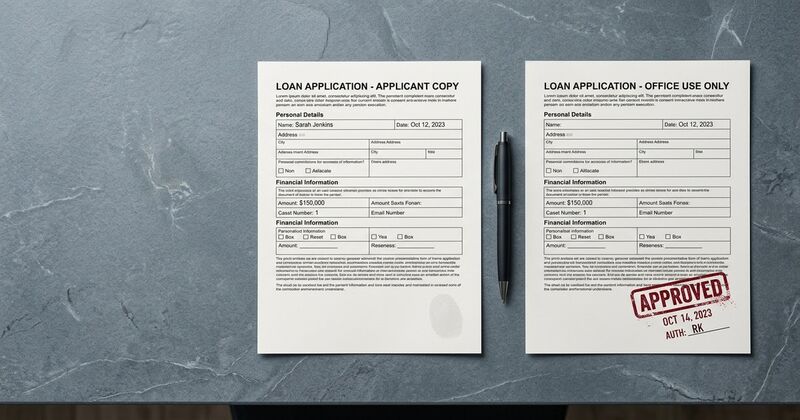


Quick answer: Pre-approval is mostly a marketing screen built on soft-pull credit data and self-reported income. Final underwriting verifies everything. The seven most common reasons a pre-approval flips to a denial: income comes in lower than stated, DTI looks worse with verified rent, new credit activity, recent job change, self-employed income mismatch, bank-statement stress signals, and identity or fraud flags.
You got the email. "Congratulations, you are pre-approved for up to $30,000 at rates as low as 8.99 percent APR." You clicked through, filled out the full application, authorized the hard credit pull, and waited. The next message was a denial. Or worse: an "approval" for $7,000 at 24 percent APR, nothing like the offer that lured you in. Your credit score is now down a few points for nothing.
This happens often enough that it deserves a real explanation, not the polite version. Pre-approval, in most online consumer lending contexts, is a marketing screen. Final underwriting is where the actual lending decision gets made. The two use different data, ask different questions, and produce different answers. Here is exactly what changes between them and what the seven most common deal-breakers actually are.
"Pre-approved" and "approved" are not the same word
Three terms get used almost interchangeably in marketing copy, and they should not be:
- Pre-qualified. Soft-pull credit check. The lender pulls a limited credit snapshot, runs your stated income and stated debts through a basic model, and shows you indicative offers. No commitment from either side. Your score does not move.
- Pre-approved. Looser term. Sometimes it means the same thing as pre-qualified (soft pull, indicative). Sometimes it means a firm offer of credit based on a prescreened credit pull (the lender bought a list of consumers fitting their criteria). Sometimes it means the lender has already pulled your full credit and you are nearly certain to be approved at the stated terms, conditional on identity and income verification.
- Approved. The lender has run the full underwriting decision, verified what they need to verify, and is committing to fund. This is a binding offer.
If you remember nothing else: until a lender uses the word "approved" without a prefix, you are looking at a marketing position, not a lending decision. The Truth in Lending Act requires APR disclosure before you commit, but that disclosure is allowed to come at the very end of the funnel. Everything before it is sales. (Our deeper guide on soft-pull vs hard-pull pre-qualification walks through the language differences in detail.)
What the soft-pull pre-qualification check actually sees
When you pre-qualify in 60 seconds on a lender's website, here is roughly what is happening behind the scenes:
- A soft credit pull (no score impact). The lender gets your FICO or VantageScore, your tradelines, and your inquiry history.
- You self-report income. Nothing is verified.
- You self-report rent or housing payment, sometimes. Often not.
- Existing debts come from your credit report only. Anything not on your report (private lender, family loan, child support, tax debt) is invisible at this stage.
- The lender's pre-qual model spits out an indicative tier. You see a rate range and a max loan amount.
None of this verifies you. It just predicts what underwriting is likely to find. The model is tuned to capture lots of leads, not to be conservative.
What changes when you click "Apply"
The full application triggers a hard credit pull and turns on the verification stack. This is where the offer can flip:
- Hard credit pull replaces the soft pull. Same credit data plus a recorded inquiry that costs typically under 5 FICO points.
- Income verification kicks in. Pay stubs, tax returns, bank statement screen-scrape (Plaid or similar), or W-2.
- Debt-to-income ratio gets recalculated using verified debts plus rent or mortgage from your bank statements, not just credit-report items.
- Identity and fraud verification runs against synthetic identity, address mismatch, and OFAC-style screens.
- Bank statement review looks for overdrafts, NSF activity, gambling deposits, and pattern volatility.
- Final pricing model runs with verified inputs.
The rate band you saw at pre-qual was based on stated inputs. The rate you actually get is based on verified inputs. If those two pictures diverge, your offer changes or disappears. Any denial decision must come with an Adverse Action Notice within 30 days, listing the principal reasons or your right to request them within 60 days. Read that notice carefully. It is the only formal explanation you are going to get.
The seven specific reasons a pre-approval gets killed at underwriting
In rough order of frequency:
1. Income verification fails or comes back lower than stated. You said you earn $84,000. Your most recent two pay stubs annualize to $71,200 because of overtime variability or a recent role change. The model reprices, sometimes to a denial at the requested loan size.
2. DTI gets recalculated with full debts. The pre-qual used your credit-report debts. Underwriting adds rent (pulled from bank statements), child support, and any unfiled obligations the bureau missed. The CFPB's DTI explainer shows the formula lenders actually run. Your stated $1,500 rent shows up as $2,400. DTI crosses the lender's cutoff. Denial.
3. New credit activity since the soft pull. You pre-qualified two weeks ago. Since then, you opened a new credit card, applied for a car loan, or maxed out an existing balance. The hard-pull file looks meaningfully different from the soft-pull file the marketing model evaluated. Underwriting prices the new file or denies.
4. Employment gap or recent job change. Most lenders want at least 90 days at current employer or two years in the same field. A recent W-2 to 1099 transition, a probationary period, or a 30-day gap will get flagged at verification even when the pre-qual model never asked.
5. Stated income vs. tax-return income mismatch. If you are self-employed and the lender pulls a 4506-T tax transcript, your reported AGI may be substantially below what you stated as gross income. This is one of the most common denial drivers for self-employed applicants. (For how to set up a clean 1099 file, see our walkthrough on getting a personal loan with no W-2.)
6. Bank statements show financial stress. Three NSF charges in the last 60 days. Overdraft transfers running constantly. Daily ending balances under $50. Even with acceptable income, this pattern triggers manual review and frequently denial.
7. Address, identity, or fraud-flag mismatch. Your application address does not match your bureau file, your driver's license, or USPS records. A name variant flags. A device fingerprint matches a fraud cluster. Some of these resolve with a phone call. Many do not.
"They quoted me 8.99 percent and gave me 24 percent. Is that legal?"
Yes, almost always. The pre-qual offer was indicative; the final offer is the one you can accept or decline. As long as the lender provided the TILA disclosures before you committed and did not engage in bait-and-switch deception (a higher bar to prove than just "the rate moved a lot"), the change is legal. It is also annoying as hell, and you are not obligated to take the new offer.
What you should do, every time, before signing: compare the actual APR, the total of payments, and the origination fee against your pre-qual quote. If the APR moved more than 2 to 3 percentage points, you have grounds to walk and pre-qualify elsewhere. The hard pull is already on your file either way.
Your rights after a denial
Under the Equal Credit Opportunity Act (Regulation B), if a lender denies you, you are entitled to:
- An Adverse Action Notice within 30 days, stating the principal reasons or your right to request them within 60 days.
- If credit information contributed to the denial, the name and contact info of the credit bureau used and notice of your right to a free credit report from that bureau under the Fair Credit Reporting Act.
- The right to dispute inaccurate information on the credit report directly with the bureau.
Use those rights. Pull the cited credit report at AnnualCreditReport.com. Make sure no fraudulent accounts, paid-off-but-still-reporting balances, or duplicate tradelines are dragging your numbers. Errors on credit reports are common, and the dispute process is free. (For the underwriter's view of why "good" borrowers get denied, see why a personal loan gets denied even with a steady job.)
What to do next without tanking your score with more hard pulls
Personal loans are not protected by FICO's rate-shopping window (that protection applies only to mortgages, auto loans, and student loans). Each new hard pull on a personal loan application stacks. Three things to do, in order:
- Wait at least 14 to 30 days before any new hard application. Let the previous inquiry settle and let your file restabilize.
- Use only soft-pull pre-qualification at the next round of lenders. Most major online personal loan lenders offer real soft-pull pre-qual. Verify the language: "no impact to your credit score" or "soft inquiry only."
- Address the specific denial reason from the Adverse Action Notice before reapplying. If DTI was the issue, pay down a card before the next pre-qual. If income verification was the issue, line up better documentation. Reapplying without changing the input that caused the denial is just paying credit-score points to learn the same lesson twice.
Why final underwriting matters for your loan
The pre-qualification funnel is designed to get you to apply, not to predict whether you will be approved. Your job is to treat the pre-qual quote as a hypothesis, not a promise, and to do the verification work yourself before consenting to the hard pull. Pull your own credit, calculate your own real DTI using your real rent and your real debts, and check your bank statements for the things underwriting will check for. If the numbers still work, apply. If they do not, the pre-qual was a mirage, and waiting to fix the inputs costs you nothing while applying anyway costs you credit-score points and time.
Common questions about pre-approval denials
What is the difference between pre-qualified and pre-approved for a personal loan?
Pre-qualified almost always means a soft credit pull and an indicative offer based on stated information. Pre-approved varies by lender: sometimes it is identical to pre-qualified, sometimes it indicates a firm offer based on a prescreened credit pull, sometimes it is a near-final approval pending verification. Approved (with no prefix) is the binding offer.
Can a lender deny me after pre-approval?
Yes. Most pre-approvals are conditional on income, identity, and debt verification, plus the absence of new derogatory credit activity. If verification produces different numbers from the ones the pre-approval model used, the offer can be reduced, repriced, or denied.
How much does a denied loan application hurt my credit score?
The denial itself does not appear on your credit report. The hard inquiry from the application does, and typically costs under 5 FICO points. Multiple hard inquiries in a short window compound and can signal credit-seeking risk to future underwriters.
What is an Adverse Action Notice?
It is a written notice required by the Equal Credit Opportunity Act. After a denial, the lender must send it within 30 days. It states the principal reasons for the denial or your right to request them within 60 days. If credit information was used, it identifies the bureau and entitles you to a free report.
Should I reapply right away after a denial?
No. Wait at least two to four weeks, fix the specific issue cited in the Adverse Action Notice, and use soft-pull pre-qualification at the next lenders before triggering another hard inquiry. Reapplying without addressing the root cause typically produces another denial.