
Quick answer: Self-employed borrowers can absolutely get personal loans. Underwriters want a four-document stack (two years of tax returns including Schedule C, recent bank statements, 1099 forms, and platform earnings exports). Income is averaged across 24 months and discounted for variability. The biggest avoidable mistake is over-deducting on Schedule C in the year before you apply.
If you drive Uber, deliver for DoorDash, run a one-person LLC, freelance from your kitchen table, or sell on Etsy, you've probably had this experience: the loan application asks for "your most recent pay stub," you stare at it, and you think, "I am the pay stub."
The good news is that lender underwriting has caught up to the gig economy, mostly. The bad news is that most of them won't tell you exactly what they want until you're three steps deep into an application. After 28 years of looking at loan files, I can tell you what an underwriter actually wants from a 1099 borrower, and how to get your file in front of them in a way that doesn't get bounced.
What "self-employed" really means to a personal loan underwriter
To the underwriter, "self-employed" is shorthand for "I can't pull a single document and verify two years of stable income, so this file is going to take more work." That's not a moral judgment. It's a workload statement.
Their job is to prove three things:
- You earn what you say you earn.
- The income is stable enough to predict for the next 36 to 60 months.
- You actually take that money home (versus showing $90k in revenue and $4k in profit after deductions).
Once you understand that's the real test, every document you send starts to make sense.
The four-document stack: 1099s, returns, bank statements
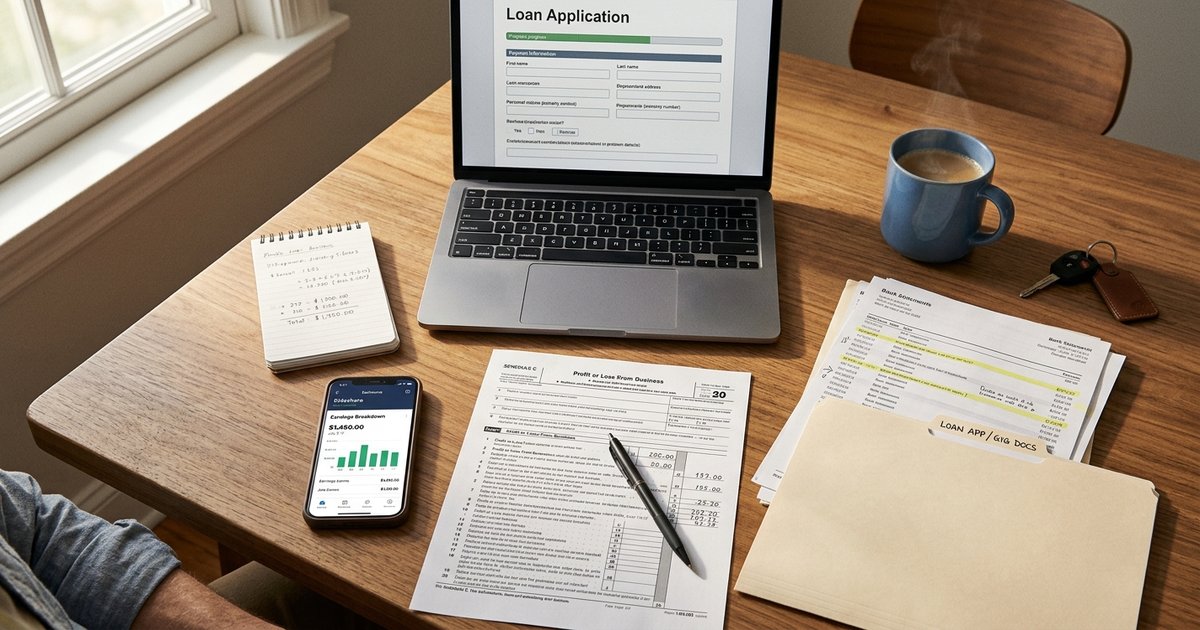
This is the file you should have ready before you fill out a single application:
1. Your last two years of federal tax returns, including Schedule C. Personal returns, not just business returns. The underwriter looks at line 31 of Schedule C (net profit) for self-employment income. They will average the last two years. According to Discover's published guidance, two years is the standard ask, though some lenders accept one year of self-employment if you have prior W-2 history in the same field.
2. The last 3 to 6 months of business and personal bank statements. All pages. Yes, the blank ones. Underwriters are looking at deposit patterns: are checks coming in regularly, what are the amounts, are there overdrafts. They're also reconciling your stated income with what actually shows up.
3. Your 1099 forms. 1099-NEC for contractor work, 1099-K from payment platforms (Uber, DoorDash, PayPal, Etsy). These prove that income reported on your tax return came from real third parties, not just numbers you typed.
4. Platform-specific earnings exports. This is the document most gig workers don't know to pull, and it's often the cleanest piece of evidence in the file.
- Uber: Tax Information page in the driver app, "Yearly Summary" PDF.
- DoorDash: Earnings tab, plus the annual 1099 from Stripe Express.
- Lyft: Driver Dashboard, Tax Information section.
- Grubhub: Driver portal, Statements.
- Instacart: Earnings section in the Shopper app.
- Etsy and Shopify: Finances or Insights area, monthly and annual sales reports.
Pull the most recent 12-month report and the year-end summary. Two documents. Three minutes of your time. Underwriters love clean platform reports because they're tamper-resistant and consistent.
How underwriters average variable income (the math nobody explains)
Here's the part that catches gig workers off-guard. Even if you made $4,800 last month, the lender doesn't approve you on $4,800.
The industry-typical formula (it varies by lender, and they don't publish the exact math) is the lower of:
- Your 24-month average of net business income from Schedule C, divided by 12.
- Your 12-month average of bank deposits attributable to self-employment.
If your Schedule C says you netted $36,000 in 2023 and $48,000 in 2024, your two-year average is $42,000. That's $3,500 a month in qualifying income. Even if December was a great month and you grossed $7,000, you're being underwritten on $3,500.
The reason is risk. The lender's modeling against the chance that next year is a bad year. They want a number that survives the slow months.
The Schedule C trap: why write-offs hurt your loan application
Every CPA in America tells gig workers and self-employed folks the same thing: maximize your deductions. Mileage, home office, phone, supplies, equipment depreciation. Drive your taxable net income down, save on taxes.
That's smart for taxes. It's brutal for loan applications.
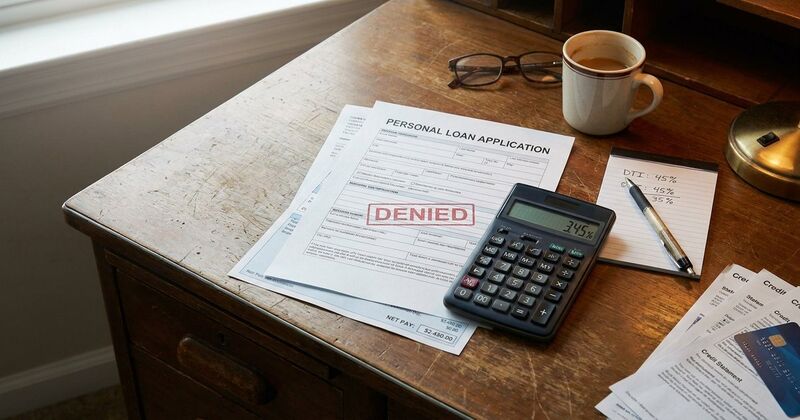
If you grossed $72,000 driving rideshare last year and deducted $34,000 in mileage and expenses, your Schedule C net was $38,000. That's the number the underwriter sees. Not the $72,000 that hit your bank account. The $38,000.
If you know you're going to apply for a loan or a mortgage in the next 12 to 18 months, talk to your CPA about how aggressively to deduct. There's a real tradeoff between tax savings and qualifying income. A few thousand dollars more on your Schedule C net can be the difference between approval and denial. Sometimes paying a little more in taxes today saves you a lot in interest tomorrow.
Cleaning up your bank statements: 90 days before you apply
Underwriters read bank statements like detectives. Here's what they flag:
- Overdrafts and NSF fees. Even one is a red flag. Three is a denial.
- Unexplained large deposits. Anything that doesn't match your stated income source. A $1,500 wire from a relative will get a "please explain in writing" letter.
- Cash deposits. Cash gets discounted heavily, sometimes thrown out entirely. The underwriter has no way to verify it came from your business.
- Payments to other lenders or buy-now-pay-later services. They're calculating your real DTI from your statements, not just your credit report. (For how DTI gets recalculated at underwriting, see why pre-approved loans get denied at final underwriting.)
- Gambling deposits or withdrawals. Not technically a denial reason on its own, but it changes the file's character fast.
Ninety days before you apply, treat your business checking like it's about to be audited. Pay yourself in clean transfers. Keep cash income out of the application story (or be ready to document it with receipts and a deposit log). Don't bounce. Don't make weird transfers. Boring is good.
Lenders that accept 1099 income on personal loans
As of writing (lender policies change, so verify before you apply), the lenders that publicly accept self-employed and gig-worker income on personal loans include Upstart, SoFi, LendingClub, Upgrade, and Avant. Most want to see at least one to two years of self-employment history and a credit score of 600 or higher. Bankrate's average personal loan rate tracker is a useful sanity check on whether the offer you're getting matches the market for your tier.
Each weighs the documentation slightly differently. Upstart leans heavily on bank-statement cash flow and is known for accepting thinner files. SoFi wants tax returns and prefers borrowers with longer self-employment history. LendingClub and Upgrade fall in the middle.
Use prequalification with soft pulls before you formally apply. It costs you nothing in credit score and it tells you what a lender will likely offer before you commit. Our walkthrough on soft-pull vs hard-pull pre-qualification covers the mechanics.
When a co-borrower or asset-based loan makes more sense
If your Schedule C is too aggressive to fix, your bank statements are messy from a slow quarter, or you just started self-employment within the last 12 months, your unsecured personal loan options will be limited and expensive. Two alternatives worth considering:
A co-borrower (often a spouse with W-2 income). The lender combines both incomes for qualification. The co-borrower has full equal liability, which is a real conversation, not a paperwork formality. (Read how to ask someone to cosign without ruining the relationship before you bring it up.)
A secured loan. If you have a paid-off car, savings, or a CD, a secured loan from a credit union usually beats any rate you'd get on unsecured 1099 underwriting. You're putting up collateral, but you're getting a real rate.
What I'd avoid: cash-advance apps marketed at gig workers (Earnin, MoneyLion-style products). The effective APRs are often well above what a personal loan would cost you, even at fair-credit rates. They're convenient. They're also a treadmill.
The documentation checklist before you hit submit
- Last 2 years of personal federal tax returns, with all schedules
- Last 2 years of 1099-NEC and 1099-K forms
- Last 3 to 6 months of personal and business bank statements (all pages)
- Year-to-date profit and loss statement (you can build a basic one in a spreadsheet)
- Platform earnings exports for the trailing 12 months
- Government-issued ID
- Proof of address (utility bill or lease)
- If applicable, business license or DBA filing
Have all of it as PDF files in one folder before you start the application. The borrowers who get approved aren't smarter than the ones who get denied. They're just more organized.
One thing to know about your rights
The Equal Credit Opportunity Act prohibits discrimination based on source of income. A lender cannot deny your application solely because your income is 1099 instead of W-2. They can decline you because the income isn't documentable, or because the math doesn't work, or because your credit isn't there. They can't decline you because you "don't have a real job." If you ever see that in writing or hear it on the phone, that's a complaint to file with the CFPB.
Trust Point Loans is not a lender or broker. We publish education for borrowers, including the self-employed and gig workers who've been underserved by traditional financial content for too long.
Common questions about self-employed personal loans
Can I get a personal loan if I've only been self-employed for one year?
Sometimes. A handful of lenders accept 12 months of self-employment, especially if you have prior W-2 history in a similar field. Expect a higher rate or a smaller loan amount than a borrower with two-plus years of self-employment.
Do lenders accept bank statements alone as proof of income?
Some do, especially online lenders like Upstart that lean on cash-flow underwriting. Most still want bank statements paired with tax returns or 1099s for the most accurate picture.
What if my tax returns show low income because of deductions?
This is the Schedule C trap. The underwriter uses your net (line 31), not your gross. If you know you're applying for a loan in the next 12 to 18 months, plan deduction strategy with your CPA accordingly.
Can rideshare drivers get personal loans?
Yes. Lenders like Upstart, Upgrade, and LendingClub accept rideshare income. Pull your annual earnings summary from Uber or Lyft, attach your 1099-K, and have at least 3 months of bank statements ready.
Do I need an LLC to qualify as self-employed?
No. Sole proprietors filing a Schedule C with their personal return qualify the same way an LLC would for personal-loan purposes. Lenders care about documented income, not entity structure.
What credit score do self-employed borrowers usually need?
600 is the common floor for online personal lenders that accept 1099 income. 670 or higher gets meaningfully better rates. High-500s scores can sometimes qualify with smaller loan amounts and higher APRs.