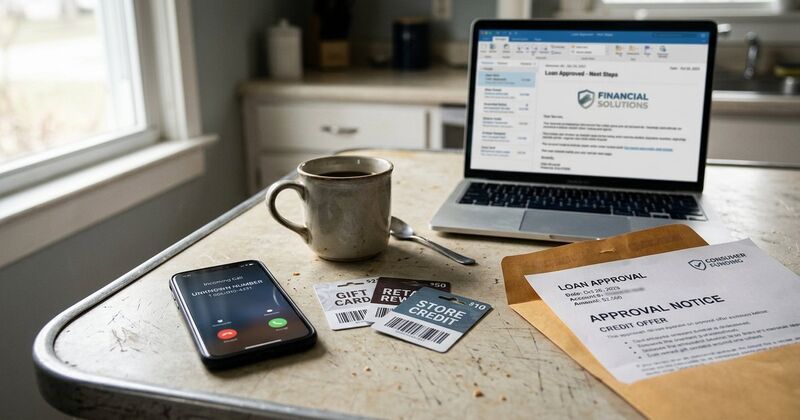


Quick answer: Debt consolidation grows debt, instead of fixing it, in five common ways: open cards drift back up, a lower payment masks a longer term and more total interest, an origination fee inflates the real APR, the underlying spending pattern was never addressed, and a short-term score hit lands at the wrong moment. Run the six-question self-check below before you click "accept."
The pre-approval email arrives on a Sunday night. $22,000, fixed rate, 60 months, one easy payment. Your credit card balances total $19,400 across four accounts, and the math, at first glance, looks like deliverance. You click. Three days later the funds clear, the cards drop to zero, and for about six weeks everything feels solved.
Then a tire goes. Then the dog. Then a slow Tuesday at work that turns into a slow month. You put $400 on a card because the cushion is not built yet. Then $900. By month nine you are carrying the consolidation loan and roughly $3,000 in fresh card debt on top of it, and your monthly minimums are higher than they were before you started.
This is the consolidation paradox, and it is the single most common way the tool meant to fix the problem grows it. A 2023 U.S. News consumer survey found that more than a third of consolidation borrowers regretted taking the loan. The CFPB puts it in plainer language: consolidation "doesn't make the debt go away." It only works if the cash flow problem that created the original balances actually changes.
If you are reading this with a pre-approval offer already open in another tab, this piece is the reality check that most consolidation content skips. There is a version of this loan that is the right move for you. There is also a version that buries you for another five years. The difference is rarely the loan. It is what you do in the 30 days after it funds.
Trap 1: The zero-balance trigger
You consolidate, the cards go to zero, and the cards stay open. That is the standard pattern, and lenders prefer it because closing accounts can shave points off your credit utilization ratio in the short term. But an open card with a $0 balance and a $7,000 limit is not a clean slate. It is a $7,000 line of credit you just gave yourself, on top of the new loan.
Experian has documented this pattern in its consumer guidance: borrowers consolidate, leave the cards open with the intent to "use them responsibly," and within 12 to 18 months are carrying meaningful new balances on top of the loan. Experian's utilization explainer spells out why open available credit is both a score asset and a behavioral risk.
If you cannot honestly say what is going to be different about your spending in month four, the cards are going to drift back up. Pretending otherwise is the most expensive part of the whole exercise. (For why a small card balance hurts your score so much more than the big new loan, see installment vs revolving and what FICO actually punishes.)
Trap 2: The lower payment that costs more
The marketing math goes like this: $19,000 in card debt at 24% APR with $600 monthly minimums, replaced by a $19,000 personal loan at 14% APR with a $440 payment. You "save" $160 a month.
The Truth in Lending math is different. The card minimums are designed to keep you in debt for decades; the personal loan has a defined payoff date. So the right comparison is total interest paid, not monthly payment. A 60-month consolidation loan at 14% costs roughly $7,400 in interest. The same balance on the cards, paid at $600 a month flat (not the declining minimum), costs roughly $5,800 over about three years.
The consolidation can still be worth it for cash-flow reasons. But "saving $160 a month" is not the same as "saving money." Stretch a balance over a longer term at a lower rate and you can absolutely pay more in total interest. Run the numbers, not the brochure.
Trap 3: The origination fee you did not notice
Personal loan origination fees commonly run 1% to 10% of the principal, and many lenders finance the fee into the loan rather than charging it separately. On a $20,000 loan with a 6% origination fee, you receive $18,800 in your account but pay interest on the full $20,000. The "headline" rate quoted in the ad is not the comparable rate.
Regulation Z, which implements the Truth in Lending Act, requires the disclosed APR to include finance charges like origination fees. That is why the APR on your final disclosure is sometimes a percentage point or two above the rate the website quoted you. Read the box. The APR is the comparable number. Anything else is marketing.
Trap 4: The cash flow problem you never fixed
This is the one nobody wants to hear. If you ran up $19,000 in card debt because your fixed expenses outrun your take-home pay, a consolidation loan does not solve that. It just resets the meter and gives you back the cards.
The CFPB is unusually direct about this in its consumer education: consolidation works when the underlying spending is addressed, and not when it isn't. That is not a moral judgment. It is mechanical. If your monthly outflow exceeds your monthly inflow by $300, the cards will be back at $3,600 in a year regardless of what loan sits next to them.
The pre-consolidation work is unglamorous. Track 60 days of actual spending (not a budget you wrote, the spending you did). Identify the gap between what comes in and what goes out. Decide which expenses are coming down and by when. If you cannot do that exercise honestly, you are not ready to consolidate. You are ready to delay the next round of pain by about nine months.
Trap 5: The short-term score hit
A consolidation loan involves a hard credit pull and adds a new account, both of which can dent your score modestly in the first couple of months. If you also close the paid-off cards immediately, you reduce your available credit and can shorten your average account age, which dents the score further.
None of this is catastrophic. But if you were planning to apply for a mortgage, refinance a car loan, or rent a new apartment in the 90 days after consolidating, the timing matters. Personal loan paid down on schedule for six months is a strong signal to future lenders. The same loan looked at three weeks after origination is a flat new debt with no payment history.
The six-question self-assessment
Answer these honestly. Out loud. To another person if you can stand it.
- Do you know, within $50, what you actually spend in a typical month? Not your budget, your actual.
- Have you tracked at least 60 days of spending in some form (app, spreadsheet, paper)?
- Is your monthly take-home pay greater than your fixed monthly outflow, or are you running at a deficit?
- Do you have at least $500 in a separate savings account that is not earmarked for anything?
- Do you know what is going to happen to the credit cards the day the consolidation funds clear (close them, freeze them, leave one for autopay only, etc.)?
- Have you read the actual loan disclosure (APR, origination fee, total of payments, prepayment penalty), not just the marketing page?
Six yeses, you are likely a good candidate. Four or five, you are close, finish the work first. Three or fewer, do not consolidate yet. The loan will be there in 60 days, and you will be in a different position to take it.
What to do before you apply
If you decided you are not ready, the next 60 days is your prep window.
Track your spending. There are free tools (Monarch's free trial, Empower, Rocket Money's free tier, a printed bank statement and a highlighter), and the tool barely matters. The act of looking does.
Build a $500 buffer in a separate account at a separate bank from your checking. The "separate bank" part matters because friction is the feature, not a bug.
Decide what is going to happen to the cards. Write it down. "I will close two of them and leave one open with a $0 balance for emergencies, frozen in the freezer, and autopay one small recurring charge to keep it active." That sentence is more valuable than a 14% APR.
Pull your free credit reports from AnnualCreditReport.com and dispute anything inaccurate. A clean report can move your score enough to drop you a tier on the consolidation rate.
When consolidation is the right move
None of this is an argument against consolidation as a tool. It is the right move when the rate math works after origination fees, when the underlying spending pattern has already changed (or has a clear, scheduled plan to change), when you have decided in advance what happens to the cards, and when you are not stretching the term so long that you pay more in total interest than you would have without the loan.
It is the wrong move when you are using it to feel better about a problem you have not actually addressed. Lenders are happy to issue you that loan either way. They are not the ones who have to live with what happens next. (For the head-to-head version of this trade-off, see consolidation loan vs debt management plan and the credit impact comparison.)
How Trust Point Loans fits your consolidation
We are not a lender or a broker. We do not earn a commission for steering you toward consolidation, and we are not going to pivot this article into an "apply now" pitch, because the entire point is that some readers should not apply at all. If you want to talk through your situation with a nonprofit credit counselor first, the National Foundation for Credit Counseling and the Financial Counseling Association of America both maintain free directories of accredited counselors. Talking to one before you sign costs nothing and tends to be the highest-leverage hour in this whole process.
Common questions about consolidation gone wrong
Will consolidating hurt my credit score?
Short term, modestly. The hard inquiry and the new account can knock your score by a handful of points for a few months. After six months of on-time payments, the same loan tends to help your score because of the steady payment history and the lower utilization on the paid-off cards.
Should I close my credit cards after I consolidate?
Closing them all at once can shorten your average account age and reduce available credit, both of which can ding your score. Many borrowers close one or two and leave one open with the card frozen and a small recurring charge on autopay. The choice depends more on your self-discipline than on the score math.
Are origination fees always financed into the loan?
Not always. Some lenders deduct them from the disbursement (you receive less than the principal); others roll them into the balance (you pay interest on the full amount). Either way, Regulation Z requires the APR disclosure to include the fee. Look at the APR, not the rate.
Is a debt management plan better than a consolidation loan?
It depends. A nonprofit DMP through an NFCC- or FCAA-accredited counselor negotiates lower rates with your existing creditors and consolidates the payments without a new loan. There is no hard pull and no origination fee, but there is a small monthly admin fee and most plans require you to close the participating cards. For borrowers with weaker credit, a DMP often beats a consolidation loan on math.
What APR makes consolidation worth it?
The directional rule: the consolidation APR (including origination fees) needs to be meaningfully below your blended card APR, and the term needs to be short enough that total interest paid is also lower. If both are not true, you are refinancing for cash flow, not for cost. That can still be a valid reason. Just know which one you are doing.