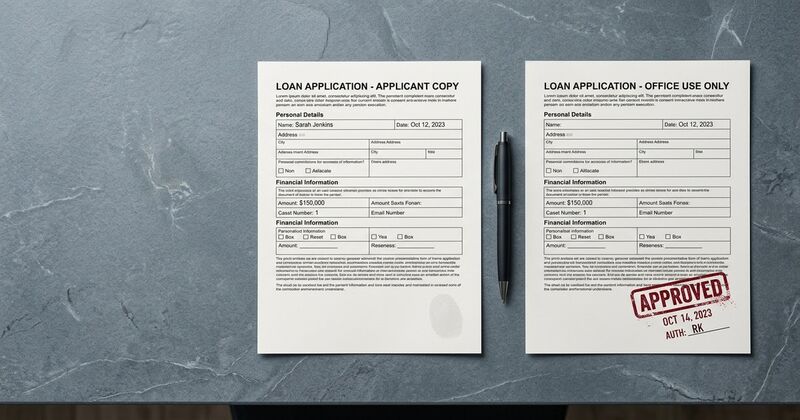

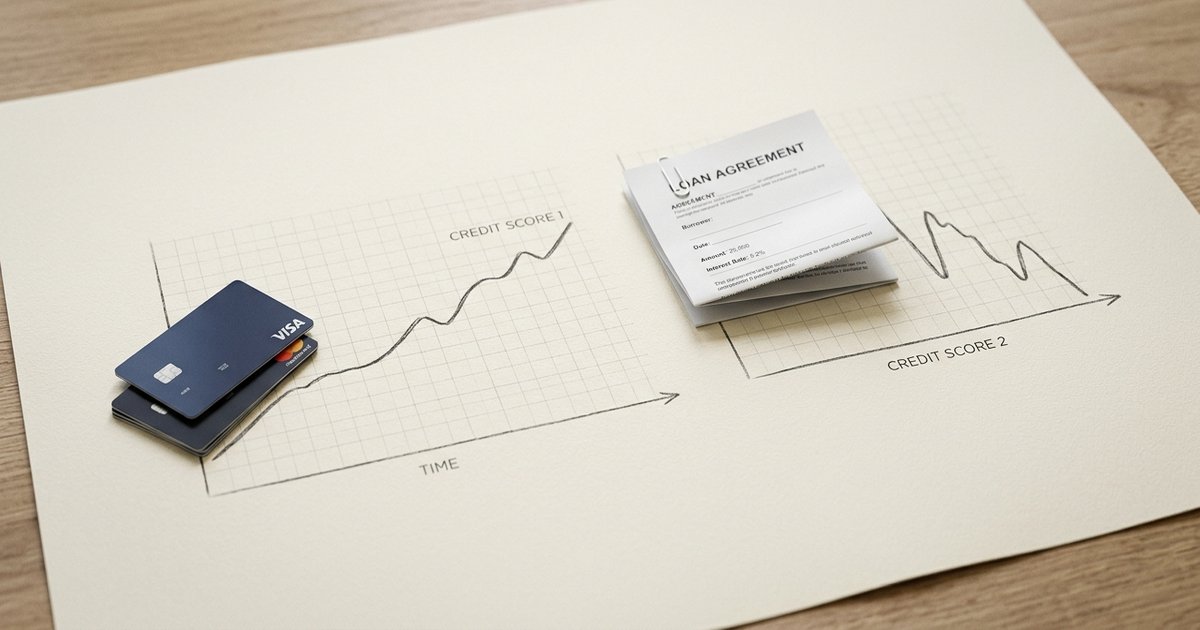
Quick answer: In month one, a consolidation loan looks better because utilization drops sharply. By month six, the two paths roughly converge for borrowers who actually pay down balances. By year two, the DMP often pulls ahead for borrowers who would have otherwise reloaded the paid-off cards. The right pick depends less on points and more on whether you tend to relapse.
The average American carrying a credit card balance is sitting on roughly $7,886 of revolving debt at an average APR above 20 percent (Federal Reserve G.19 and Bankrate, late 2025). At that rate, the minimum payment is mostly interest. Two paths get most of the search traffic from people trying to escape that math: a debt consolidation personal loan and a nonprofit debt management plan (DMP). And the question that keeps coming up in forums, almost word for word, is the same: which one will hurt my credit score less?
Short answer: in the first month, the consolidation loan looks better. By month six, they roughly converge for borrowers who actually pay down balances. By year two, the DMP often pulls ahead for borrowers who would have run the cards back up. The fuller answer involves what each option actually does to the components of your FICO score, and which type of borrower you are.
First, get the definitions straight
These three things are not the same product, and confusing them is how borrowers end up with the wrong tool:
- Debt consolidation loan. A new unsecured personal loan that pays off your existing credit card balances. You owe one lender, ideally at a lower APR. Your cards stay open. You manage payoff yourself.
- Debt management plan (DMP). A structured repayment plan administered by a nonprofit credit counseling agency. The agency negotiates lower interest rates with your card issuers (typically 6 to 10 percent), you make one monthly payment to the agency, the agency pays the creditors. Enrolled cards are usually closed during the plan.
- Debt settlement. A different product. Usually for-profit. The "settlement" company tells you to stop paying creditors so they can negotiate reduced lump-sum payoffs. This wrecks your credit (charge-offs, settled-for-less-than-owed flags) and is not a near substitute for either of the above. If anyone selling you a "program" tells you to stop paying your creditors, you are looking at debt settlement, not a DMP.
The rest of this article is about the first two only. (For why a consolidation loan can grow debt instead of shrinking it, see when debt consolidation makes your debt worse.)
Day 1: what shows up on your credit report
The day you sign up for either path, your credit file changes in different ways.
With a consolidation loan:
- One hard inquiry hits your report. Typically under 5 FICO points, sometimes a touch more if your file is thin.
- A new installment account appears. Average account age drops slightly (about 10 percent of FICO).
- Once the loan funds and you pay off cards, revolving utilization can drop significantly. This is the biggest near-term mover.
With a DMP:
- No hard inquiry. Credit counseling enrollment does not pull a hard credit report.
- Enrolled cards are typically closed by the issuer at the agency's request. Closed accounts in good standing keep contributing to length of credit history for years, but they stop contributing to your available credit limit.
- Available revolving credit drops, which means your utilization ratio jumps even if you owe the same amount.
- Some issuers add a notation to the account indicating it is being paid through a credit counseling agency. FICO does not directly score this notation, but lenders can see it during manual review.
The Day 1 picture: the loan typically costs you a small dip from the inquiry but rewards you with a utilization drop. The DMP avoids the inquiry but punishes you with a utilization spike. In points, the loan usually wins month one.
Months 1 to 6: what changes underneath
This is where the picture gets more interesting and where most articles stop short.
Consolidation loan borrowers see the cleanest gains. Experian's own analysis shows that borrowers who consolidate and do not run their cards back up typically recover from the inquiry and exceed their starting score within three to six months. Utilization is roughly 30 percent of FICO. Moving from 80 percent utilization to 10 percent is one of the biggest single moves the model rewards. (For why utilization carries this much weight, see why a small card balance hurts your score more than a big car loan.)
But here is the trapdoor: more than a third of consolidation borrowers regret the decision, according to a 2023 U.S. News survey, and the most common reason is exactly what you would expect. The cards got paid off. The credit limits stayed open. New balances appeared. Twelve months later, the borrower has the personal loan AND fresh card debt, and the score that briefly improved is now lower than where it started.
DMP enrollees, in contrast, cannot easily run cards back up because the cards are closed. Their score in months 1 through 6 typically lags the consolidation borrower's because of the utilization spike from closed accounts and the persistent lower available credit. Money Management International (MMI), one of the larger NFCC-accredited counseling agencies, reports that clients on plans see scores improve by 60 or more points after roughly two years. That number is internal data, not independently audited, but it is directionally consistent with how the FICO model rewards consistent on-time payments and falling balances over time.
Year 1 to year 2: the recovery curves diverge
By the end of year two, the two paths look very different depending on who you actually are as a borrower.
The disciplined consolidator (paid the loan, did not reload the cards) is in the best shape. Score is up by 30 to 80 points from baseline, depending on starting utilization, and the loan's installment history is now adding positive depth to the file. Their total cost of getting out of debt was lower because the personal loan APR (say 12 to 15 percent) beat the card APRs (say 22 to 26 percent) for the entire repayment period.
The undisciplined consolidator is worse off than when they started. New card balances at the same high APRs, plus the personal loan on top.
The DMP enrollee is roughly where the disciplined consolidator is, sometimes ahead in points, sometimes behind, but with one big behavioral difference: the cards were not available to be run back up. The structural guardrail did the work that willpower would have had to do alone on a consolidation loan. By the time the plan completes (typically 3 to 5 years), accounts can be reopened, and the credit history of the closed accounts continues to count for length of credit history.
The DMP notation on the account, by the way, is sometimes described as staying for "up to 6 years." The reality is messier. FICO does not directly score the notation. Lenders may see it during manual underwriting if it is still there during your enrollment, but it does not function like a public-record judgment or a charge-off.
Who qualifies for each
This part decides the question for many borrowers before any credit-impact analysis matters.
To qualify for a consolidation loan at a competitive APR, you generally need:
- FICO around 670 or above for the lowest tier of rates. Borrowers in the 600 to 660 range can usually qualify but at APRs in the high teens to mid 20s, which may not beat their card rates by enough to matter.
- A debt-to-income ratio under roughly 40 to 45 percent.
- Verifiable income.
- No recent serious delinquencies.
To qualify for a DMP, you generally need:
- Enough monthly income to cover the agency's proposed plan payment.
- Eligible debt (mostly unsecured credit cards, sometimes medical and personal loans).
- That is essentially it. There is no minimum credit score.
If your credit is already damaged enough that consolidation loan offers are at 28 percent APR or higher, the consolidation math no longer works. A DMP almost always beats that scenario because the agency-negotiated rates land in the 6 to 10 percent range regardless of your credit.
The "I qualify for a loan but should I do a DMP anyway" question
This is the question I think is genuinely worth thinking about, and most articles dodge it. If you can qualify for a 12 percent consolidation loan but you have a long history of running balances back up, the DMP is probably the credit-friendlier choice over a 24-month horizon, not because it scores better in month one, but because it removes the trapdoor. The cards get closed. You cannot relapse.
If your past behavior says you can pay off and stay off, the consolidation loan wins on every dimension: faster recovery, lower total interest, no agency fee (DMPs typically charge $25 to $75 per month), and no notation on enrolled accounts.
Be honest with yourself about which one you actually are. The data on consolidation regret is not subtle.
What to ask any agency before you enroll
If you are leaning toward a DMP, a few non-negotiables:
- Are you accredited by the NFCC or FCAA? If not, walk away. There is no reason to use a non-accredited agency.
- Are you a 501(c)(3) nonprofit? Real DMPs are nonprofit. For-profit operators usually steer you to debt settlement.
- What is the monthly fee, and what does the setup fee look like? Reasonable: $25 to $75 monthly, setup under $75. Anything materially higher is a flag.
- What APRs have you negotiated with my specific creditors recently? Good agencies will tell you typical ranges by issuer. Vague answers are a flag.
- Will you provide a written analysis of my budget before recommending a plan? Yes is the only correct answer.
- What happens if I miss a plan payment? Most plans drop you back to the original creditor terms after one or two missed payments. You should know this going in.
Why the credit impact matters for your choice
The credit-impact question is real, but it is not actually the most important question. The most important question is which structure makes it more likely you finish the job. A consolidation loan with cards that stay open is a higher-ceiling, higher-failure-risk path. A DMP is a lower-ceiling, lower-failure-risk path with a built-in guardrail. The credit math will sort itself out at the end of either if you actually complete the plan. The credit math destroys you on either if you do not. Pick the one that matches the borrower you have actually been over the last three years, not the one you intend to become.
(For a broader walkthrough of the four real escape routes for a five-figure card balance, see our companion piece on $8,000 credit card debt and your real options.)
Common questions about consolidation loans vs DMPs
Does a debt management plan hurt your credit score?
Short term, often yes, mostly because enrolled credit cards are closed, which spikes your utilization ratio. The FICO model does not directly score the DMP notation, but lenders may see it during manual review. Long term (year 2 and beyond), the consistent on-time payments typically produce score gains. MMI reports clients see roughly 60-point improvements after two years on plan.
Is a consolidation loan better than a debt management plan?
Better is borrower-specific. If you can qualify for a sub-15 percent APR and you have a track record of not running balances back up, the consolidation loan usually wins on speed and total cost. If your credit will only get you a 25 percent-plus offer, or if you have repeatedly reloaded paid-off cards, a DMP is usually the safer path.
Will my credit cards be closed if I enroll in a DMP?
Almost always, yes. Most card issuers close enrolled accounts as a condition of accepting the DMP's lowered rate. You may keep one card outside the plan for emergencies, but enrolled cards close.
How long does a DMP stay on your credit report?
The DMP notation itself is not a derogatory mark and is not weighted by FICO scoring. It may be visible to lenders for the duration of the plan and sometimes shortly after. Closed accounts in good standing remain on your report for up to 10 years and continue contributing to length of credit history.
Is a debt management plan the same as debt settlement?
No. A DMP is a nonprofit-administered repayment plan where you pay your creditors in full at lower interest rates. Debt settlement is a for-profit product where you stop paying creditors so a settlement company can negotiate reduced payoffs. Settlement causes serious credit damage. DMPs do not.