

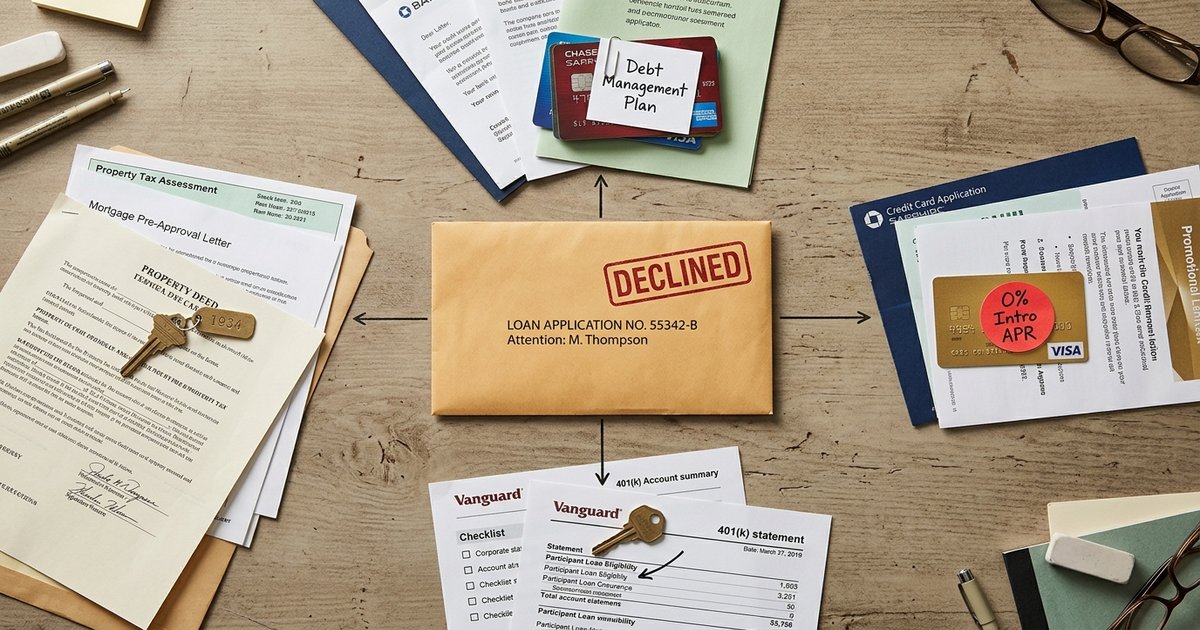
You already tried. Maybe twice. The personal loan applications came back declined, the prequalification offers quoted you APRs that made the math worse than what you have today, and every article you read seems to assume the door you are standing in front of is open.
It is not. So here are four paths that do not require a personal loan, with honest underwriting requirements, the disqualifiers that send each one from "viable" to "wrong choice," and what each one really costs.
The wall every declined borrower hits
Average commercial-bank personal loan APRs sat near 12.26% in early 2026 according to the Federal Reserve's G.19 Consumer Credit release. That number hides the spread. Bankrate's tier breakdown for May 2026 showed fair-credit borrowers averaging 19.73% and poor-credit borrowers seeing 25.99% to 35.99%.
Most prime personal loan lenders also cap accepted DTI at 50% and prefer it under 36%. So the borrower carrying $40,000 in revolving debt at a 51% DTI hits two walls at once: the FICO wall and the DTI wall. The unsecured consolidation pitch breaks down right where the people who need it most are standing. If you are weighing whether to stretch for the loan or wait, our breakdown of what a 580 FICO actually costs compared to a 680 on a $15,000 loan runs the dollar gap.
Here are the four real alternatives, ranked by how often I have seen each one work in practice.
Path 1: Nonprofit Debt Management Plan (DMP)
Best for: $5,000 to $60,000 in unsecured debt, steady income, willingness to commit to 36 to 60 months, you want a single monthly payment.
A DMP is not a loan. It is a structured repayment plan administered by a nonprofit credit counseling agency (NFCC.org is the right starting point). You make one payment to the agency every month. The agency disburses to your creditors. Your creditors agree to reduced APRs and waived fees in exchange for the steady payment.
Real numbers. NFCC member agencies typically run DMPs over 36 to 60 months. Concession APRs from creditors generally fall in the 6% to 9% range, though the agency will not promise a specific rate before they negotiate. Monthly admin fees are capped by state regulators.
Real outcome from r/personalfinance: "Started a DMP through NFCC. My APRs dropped from 27% to 7% on four cards. Hardest part was the 60-month commitment, not the closing of the cards."
What it actually looks like: most DMPs require you to close the credit cards enrolled in the plan. That stings the score short term because closed accounts shrink available credit and shorten average account age. You will not be able to use those cards during the program. The trade is a single fixed payment, lower interest, and a clean payoff date.
Disqualifiers:
- Income that cannot cover the proposed monthly payment after housing and basic expenses.
- Debt that is mostly secured (auto, mortgage) or non-traditional (medical, tax). DMPs work for credit cards and some unsecured personal loans. Not for everything.
- You cannot commit to closing the cards. If the cards stay open and you keep using them, the DMP fails inside 90 days.
The CFPB on DMPs vs debt settlement: nonprofit credit counselors are explicitly distinct from for-profit debt-settlement firms. The CFPB explainer on credit counseling vs debt settlement spells out the difference: counselors collect a single payment and disburse to creditors. Settlement firms tell you to stop paying, hold your money in escrow, and try to negotiate lump-sum settlements that destroy your credit and may produce a 1099-C taxable forgiveness event. Do not confuse the two.
Path 2: Balance Transfer Card
Best for: 700+ FICO, debt clearable in 15 to 21 months, no other large purchases planned during that window.
A balance transfer card with a 0% intro APR moves your existing balances to a new card at no interest for a promotional period (commonly 15, 18, or 21 months). The Truth in Lending Act (Reg Z) requires the introductory APR to remain in effect for at least six months unless the cardholder is more than 60 days late.
The catch is the transfer fee, almost always 3% to 5% of the transferred balance, charged up front and added to the balance. So a $10,000 transfer at a 5% fee starts as $10,500 of debt. You do not earn the math back unless you pay it off before the promo ends.
Real failure mode from r/personalfinance: "Did a 0 percent balance transfer, paid the 5 percent fee, and forgot to pay it off in 18 months. Got hit with retroactive interest."
Some cards charge retroactive interest on the entire transferred balance from day one if any balance remains at the end of the promo. Others charge interest only on the remaining balance going forward. Read the disclosure box. The two structures are very different.
Disqualifiers:
- FICO under 680. Most 0% intro offers go to 700+ borrowers.
- You cannot pay the full balance off inside the promo window. Run the math on Day 1: total transferred + fee, divided by promo months. If the resulting monthly payment is more than you can sustainably hit, this is a trap.
- You plan to keep using the card for new purchases. New purchases often accrue interest immediately under different terms while the transferred balance sits at 0%, and minimum payments do not have to be applied to the transferred balance first.
Path 3: 401(k) Loan
Best for: Stable W-2 employment, no near-term layoff risk, vested balance over $30,000, you genuinely intend to pay yourself back.
The IRS lets you borrow the lesser of 50% of your vested 401(k) balance or $50,000, with standard repayment over five years (longer if you use it to buy a primary residence). The IRS retirement topics page on plan loans spells out the rules. Multiple-loan rules reduce the $50,000 cap by your highest outstanding balance in the prior 12 months.
Interest rate is typically prime plus 1% or 2%. The interest you pay goes back into your own account, which sounds fine until you understand the actual cost.
The real cost is the under-disclosed risk: if you separate from your employer (quit, get laid off, get fired), most plans accelerate the loan. The remaining balance becomes due, often within 60 to 90 days. If you cannot repay, the unpaid balance is treated as a deemed distribution. That means it is taxable as ordinary income, and if you are under 59 and a half, you owe an additional 10% early-withdrawal penalty on top.
r/personalfinance, paraphrased: "Took a 401(k) loan to clear cards. Got laid off four months later. Now I owe taxes and a 10 percent penalty on top of the balance."
The other cost nobody puts on the marketing page: opportunity cost. The money you borrowed is no longer invested. If the market returns 8% during the year your money is out and your loan rate is 9%, you lost the 8% return on those dollars on top of the interest you paid.
Disqualifiers:
- Your employer's plan does not allow loans. Not all do. Check your Summary Plan Description before assuming.
- Job stability is shaky or industry layoffs are likely.
- You are within five years of retirement and would be permanently reducing the principal that compounds for you.
- Vested balance is small enough that you would be borrowing more than 50% by going to a different option.
Path 4: Home Equity Line of Credit (HELOC)
Best for: Homeowner with 20%+ equity, 660+ FICO, willing to put the house behind the debt, 5 to 10 year payoff horizon.
HELOCs let homeowners draw against their home equity at variable rates that have come down meaningfully. LendingTree's marketplace data showed an average HELOC rate of 7.09% on a $100,000 line in March 2026, down from 8.78% in March 2025. Bankrate's national index ran near 8.25% the same month.
2026 underwriting standards: most lenders require a minimum 620 to 660 FICO, 15% to 20% equity, and DTI under 43%. Best rates require 720+.
Debt consolidation is now roughly 39% of HELOC and home-equity origination volume according to LendingTree marketplace reporting cited by Bankrate, up from 25% in 2022. Homeowners are leaning on equity as unsecured loan denials rise.
The trade is real. You are converting unsecured debt (worst case: bankruptcy and discharge) into secured debt against your house (worst case: foreclosure). That is not a small trade. If your income is stable and you treat the HELOC as a fixed-payoff schedule rather than a revolving slush fund, it can work. If you draw the line, pay down some of it, then draw again to cover a vacation, you have just used your house to fund a vacation at 7% APR. Don't.
Disqualifiers:
- Less than 15% equity. Most lenders will not write the line.
- DTI over 43%. The HELOC does not get approved at the rate you want.
- Job or income volatility. A variable-rate line tied to your house is not for someone who might miss a payment.
- You are likely to sell the home in 1 to 3 years. The HELOC has to be paid off at sale and the closing costs eat the savings.
HELOCs are mortgages and trigger TRID disclosures, a three-day right of rescission for primary residences, and lien priority changes. Read the closing package. Do not skim it.
The decision matrix
One screenful, by profile:
- FICO 580 to 660, mostly card debt, steady income, no home equity: Path 1 (DMP) first. Period.
- FICO 700+, $5,000 to $15,000 of card debt, can pay off in 15 to 21 months: Path 2 (balance transfer) is the cheapest option that exists.
- FICO under 680, no equity, stable W-2 with healthy 401(k): Path 3 (401(k) loan) only if you are confident in the job and the balance is large enough. Otherwise Path 1.
- Homeowner with 20%+ equity, 660+ FICO, $30,000 or more to consolidate: Path 4 (HELOC) at 2026 rates is mathematically the cheapest path. The risk is real and worth a second conversation before signing.
- DTI over 50%, no equity, FICO below 600, multiple maxed cards: Path 1 with a hard look at whether bankruptcy counsel belongs in the same conversation.
If you do still have room to qualify, our $24,000 credit card payoff case study walks through what a structured consolidation actually looks like in practice.
What to skip
For-profit debt settlement. The pitch is "stop paying, save the money in escrow, we'll negotiate lump-sum settlements at 40 cents on the dollar." The reality is your accounts go delinquent, then to collections, your credit is destroyed for years, the IRS may issue 1099-C forms for forgiven debt as taxable income, and many creditors refuse to settle at all and instead sue. This is a different product than a DMP.
Debt consolidation companies that charge upfront fees. If a company is asking for a fee before doing anything, they are operating in violation of the Credit Repair Organizations Act if they market credit-repair services, or operating as a debt-settlement firm dressed in different clothing. Walk away. Our piece on how to spot a personal loan scam goes deeper on the warning signs.
Aggressive home-equity callers. If you are getting calls or letters telling you that you "qualify for a $50,000 home equity loan" without any application, that is a marketer, not a lender. Apply through a bank, credit union, or HELOC marketplace you sought out yourself. Never one that came to you.
Trust Point Loans is not a lender, broker, or financial advisor. We publish guides like this so borrowers who got declined for a personal loan can see the actual options that fit their situation.
Frequently Asked Questions
Will a Debt Management Plan hurt my credit score?
Short term, yes, mostly because most DMPs require you to close enrolled cards. That shrinks available credit and shortens average account age. Long term, the lower utilization, on-time payments, and eventual payoff usually leave borrowers ahead of where they started.
Can I do a balance transfer with a 650 FICO?
Possibly, but the offers will be limited and the promo lengths shorter (often 12 months, sometimes 0% on purchases only, not on transfers). Most strong 18 to 21 month 0% transfer offers go to 700+ borrowers. Pre-qualify first to see what you are actually offered.
What happens to my 401(k) loan if I quit my job?
Most plans require the outstanding balance to be repaid within 60 to 90 days of separation. SECURE Act changes extended this for some plans. If you cannot repay, the balance becomes a deemed distribution, taxable as ordinary income, plus a 10% early-withdrawal penalty if you are under 59 and a half.
Is a HELOC cheaper than a personal loan?
At 2026 rates, the average HELOC sits around 7% to 8%, well below the 12% to 30% range for personal loans. The trade is that the HELOC is secured by your home and the rate is variable. Run the math at the upper end of the rate range, not the marketing rate.
Can a nonprofit credit counselor help me even if I cannot afford the proposed payment?
Yes. NFCC member agencies do free initial budget reviews even if a DMP is not the right fit. They can help you understand cash-flow gaps, identify whether bankruptcy counsel is worth a conversation, and review hardship options with specific creditors.
Should I just file bankruptcy instead?
Bankruptcy is a real tool, not a moral failing, and a nonprofit credit counselor can help you decide whether it makes more sense than a five-year DMP. Chapter 7 wipes most unsecured debt in three to four months. Chapter 13 sets up a court-administered repayment plan. Talk to a nonprofit counselor and a consumer bankruptcy attorney before deciding.