

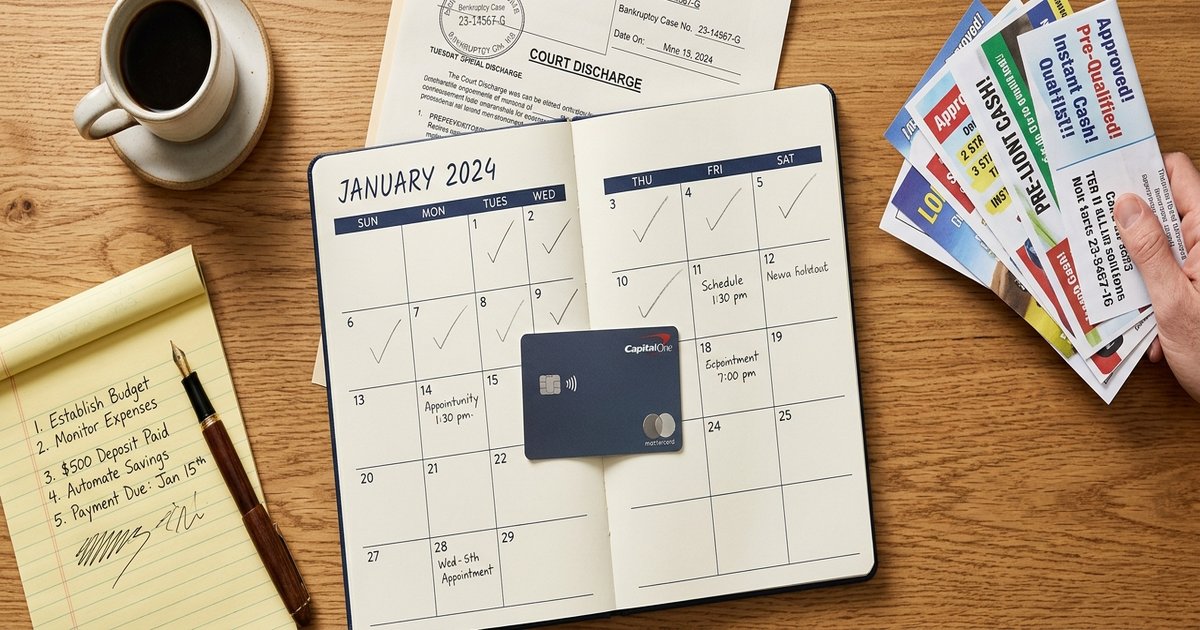
The first solicitation arrived in his mailbox eight days after the discharge. By the end of the second week, he had three more in the mail and four in his email, all offering "fresh start" personal loans, subprime auto refinances, and unsecured cards with $99 annual fees plus monthly maintenance charges. He filed Chapter 7 in February, walked out with a discharge in May, and by Memorial Day his inbox looked like a junk drawer.
"Some company offered me a $5,000 personal loan a month after discharge. Is it a scam?" That is a real question pulled from r/bankruptcy, and the honest answer is usually: not technically a scam, but priced to exploit you, and almost never the right move at month one. The first 12 months after a Chapter 7 discharge have a sequence. Some moves help. Some moves cost you years. This piece walks the calendar.
One ground rule before the calendar: this is consumer-finance reporting, not legal advice. If you have any question about your discharge order, post-discharge collection attempts, or the specific debts that did or did not get included, talk to your bankruptcy attorney. The bar is low to call back; most will answer a quick question for a former client without billing.
The first 30 days: stop, document, pull your reports
Before anything else, save the discharge order. The PDF from the court is the single most important post-bankruptcy document you own. The U.S. Courts overview of bankruptcy discharge walks through what the order does and which debts it covers. It proves the debts in your schedules were discharged, and you will reference it for years.
Then pull all three credit reports. AnnualCreditReport.com is the federal portal, free, and gives you Equifax, Experian, and TransUnion. Read every trade line. Every debt that was discharged in your Chapter 7 should be marked "discharged in bankruptcy" or "included in Chapter 7" with a zero balance. The bankruptcy itself will show on the report for 10 years from the filing date under FCRA section 605. The discharged trade lines should not show ongoing balances, current statuses, or active collection.
The CFPB's resource on credit reports and scores is the right starting point if you have never disputed an item before.
Days 30 to 60: dispute every discharged debt that is reporting wrong
This is where most rebuilders leak time. Charge-offs, collections, and old accounts often continue to report a balance after discharge. They should not. File a written dispute with the bureau under FCRA section 611, attach a copy of the discharge order and the relevant page of the schedules, and identify each trade line by account number.
The bureau has 30 days to investigate, contact the furnisher, and verify, correct, or delete the item. If the furnisher cannot verify a balance that contradicts your discharge, the item gets corrected or deleted. If a creditor is actively trying to collect on a discharged debt, that violates the 11 USC 524 discharge injunction, and your bankruptcy attorney can move the bankruptcy court for sanctions. Save every collection letter and voicemail.
Borrowers I have talked to are routinely surprised at how much score lift comes from cleaning up post-discharge reporting errors alone. The bankruptcy itself drops a typical FICO between 130 and 240 points (Experian's published range). A handful of incorrectly-reporting trade lines can subtract another 30 to 60 on top. Fixing those is the highest-leverage move of the year.
Months 2 to 3: open one secured card
One. Not three. Not a stack of subprime offers from the mailbox.
A secured card requires a refundable cash deposit, typically $200 to $2,500, that becomes your credit limit. Most major issuers (Discover, Capital One, Bank of America, Self) offer them, report to all three bureaus, and graduate to unsecured after 6 to 18 months of on-time use, returning your deposit. Many credit unions offer better terms than national issuers if you are eligible to join (the NCUA's consumer site has a credit union locator).
The mechanics that matter:
- Set autopay for the statement balance. Not the minimum, the full statement.
- Use the card for one or two small recurring charges (a streaming subscription, a phone bill).
- Keep the reported balance under 10% of the limit. If your limit is $300, that means under $30 reporting at statement close.
- Confirm the issuer reports as a revolving credit account, not a secured loan.
FICO weights payment history at 35% and amounts owed at 30%. A secured card used this way moves both, while keeping you out of every fee trap on the market. Our three credit score moves that work in 60 days covers utilization timing in detail.
Months 3 to 4: add a credit-builder loan
FICO weights credit mix at 10%. After a Chapter 7, your file has no positive installment history. A credit-builder loan fixes that.
The structure is unusual: the lender holds the loan proceeds in a CD or savings account while you make monthly payments. At the end of the term, you receive the proceeds (less interest and fees). The payments report to the bureaus as installment loan history. Self, Credit Strong, and most credit unions offer them. Pick a 12 to 24 month term with a payment that fits a tight budget. A $25 monthly payment that you make every time beats a $75 monthly payment you miss once.
The "do not do" list, months 1 to 6
The wave of post-discharge solicitations is the single biggest risk to your year-one plan. Filers commonly receive subprime auto and card offers within 7 to 30 days of discharge.
The categories to refuse, on sight:
- Subprime auto refinance offers at 25 to 35% APR. If you have an auto loan that survived the bankruptcy, the right time to refinance is after 12 months of clean post-BK payments and a meaningful score recovery, not month two.
- Unsecured cards with annual fees plus monthly maintenance fees. The structure to avoid: $99 annual fee, $10 to $12 monthly fee, $75 setup, low limit. The math eats your limit before you spend a dollar.
- "Fresh start" personal loans at 35.99% APR (or right at your state's usury cap). They will approve you at month two because the math works for them, not for you.
- Anything that asks for an upfront fee. The Telemarketing Sales Rule (16 CFR 310.4) and FTC Act Section 5 prohibit advance fees in exchange for promised loans. Real lenders deduct origination fees from the loan proceeds, not before.
Our companion piece on how to spot a personal loan scam walks the same warning signs in detail. The wariness in r/bankruptcy threads about these offers is correct. Validate it.
Months 6 to 9: pull a free FICO and confirm progress
Most secured-card issuers now provide a free FICO score on the monthly statement or in the mobile app. Experian, Capital One CreditWise, and the bureaus' own consumer apps also display scores. By month six, with the bankruptcy reporting cleanly, a secured card paid on time, and a credit-builder loan in payment, you should see a measurable bounce. Bankrate's published timelines suggest disciplined rebuilders typically reach the mid-600s within 12 to 18 months and 700+ within 3 to 5 years.
If your score is not moving, audit. Pull all three reports again. Look for new errors. Check that your secured card and credit-builder loan are actually reporting (some smaller issuers report only to one or two bureaus, which limits the lift).
Months 9 to 12: consider one more positive trade line
By month nine, most rebuilders have one secured card, one credit-builder loan, and a cleaning credit file. A second secured card or a small credit-union installment loan can add the credit-mix and payment-history depth that lenders want to see in year two.
Two rules: do not exceed two new accounts in year one, and keep utilization low. Each new account briefly drops your average account age, which hurts before it helps. Two well-managed accounts are the limit before the next phase of the plan.
End of year one: realistic expectations
If everything went right (clean disputes, on-time payments, low utilization, no new derogatories), you are likely sitting in the mid-600s FICO. That number unlocks:
- Second-tier unsecured cards with fewer fees.
- Credit-union personal loans at moderate rates.
- Auto loans at non-subprime rates if you are willing to put 15 to 20% down.
It does not yet unlock most prime fintech personal loans. Lender disclosures across major fintechs show waiting periods of typically 12 to 24 months post-discharge with a 660 to 680 FICO and a clean post-BK history. Banks tend to be longer, often 24 to 48 months. Mortgage waiting periods are longer still: FHA's typical waiting period is two years from discharge, conventional Fannie/Freddie usually four years (consult a loan officer for current standards).
Year two outlook: the unsecured personal loan window
Around the 24-month mark, with a 660+ FICO and 24 months of clean reporting, most fintech personal lenders open up. The right move is the same as for any borrower: prequalify (soft pull) at two or three lenders before submitting a hard application, read the disclosure box carefully, and compare APR, finance charge, and total of payments rather than just the marketing rate. Our piece on the five personal loan numbers that decide whether a loan is worth taking walks the comparison.
If you are denied at month 24, the adverse action notice tells you why. Read it as a diagnostic. The four principal reasons rule under ECOA Reg B gives you exactly what to fix before the next application. Our piece on your rights when a lender denies you walks the letter line by line.
Your protective rights, in plain English
A short reference card to keep nearby:
- Discharge injunction (11 USC 524): creditors cannot try to collect on debts discharged in your Chapter 7. Violations are enforceable through the bankruptcy court.
- FCRA section 605: the bankruptcy reports for 10 years from filing date. Discharged debts must show as discharged with zero balance.
- FCRA section 611: right to dispute inaccurate items. Bureaus must investigate within 30 days.
- ECOA Reg B (12 CFR 1002.9): if a lender denies you, you are entitled to specific reasons (up to four), the credit reporting agency used, and a free credit report within 60 days under FCRA section 615(a).
- 11 USC 525: certain anti-discrimination protections based on bankruptcy status, mostly applicable to governmental units. Private lender protections are narrower; talk to your attorney.
- CFPB complaint database: the right venue for post-discharge collection violations, inaccurate reporting, or vague adverse action notices. Companies generally respond within 15 days.
The discharge gave you a legal restart. The first year decides how fast the credit file catches up. Pick the small moves, refuse the loud offers, and let the calendar do the rest.
Frequently Asked Questions
How long after Chapter 7 can I get a personal loan?
Most fintech personal lenders require 12 to 24 months post-discharge with a 660+ FICO and clean post-BK credit history. Traditional banks usually require 24 to 48 months. The exact waiting period varies by lender and is disclosed in their underwriting guidelines.
How long does Chapter 7 stay on my credit report?
10 years from the filing date under FCRA section 605. Individual discharged trade lines remain for up to 7 years from the date of first delinquency before the bankruptcy.
Are the loan offers I'm getting right after discharge legitimate?
Some are technically legitimate but priced to exploit, with high APRs, fee-stacking, and short terms. Others are outright scams demanding upfront fees, gift cards, or wires. The Telemarketing Sales Rule (16 CFR 310.4) prohibits advance fees in exchange for promised loans. Verify every lender on NMLS Consumer Access and your state regulator before responding.
What's the fastest way to start rebuilding credit after Chapter 7?
Pull all three reports, dispute every discharged debt that is still reporting a balance, open one secured card with autopay set to the full statement, and add one credit-builder loan a few months later. Keep utilization under 10%, pay on time, and avoid new credit beyond those two accounts in year one.
Can creditors keep trying to collect on discharged debts?
No. The 11 USC 524 discharge injunction prohibits collection on discharged debts. Save every collection letter, voicemail, and statement, and contact your bankruptcy attorney; the bankruptcy court can sanction violations.
What credit score can I realistically reach in year one?
Disciplined rebuilders typically reach the mid-600s within 12 to 18 months, according to published timelines from Bankrate and Experian. Outcomes depend on starting score, post-BK income stability, accuracy of credit reporting, and absence of new derogatory items.