

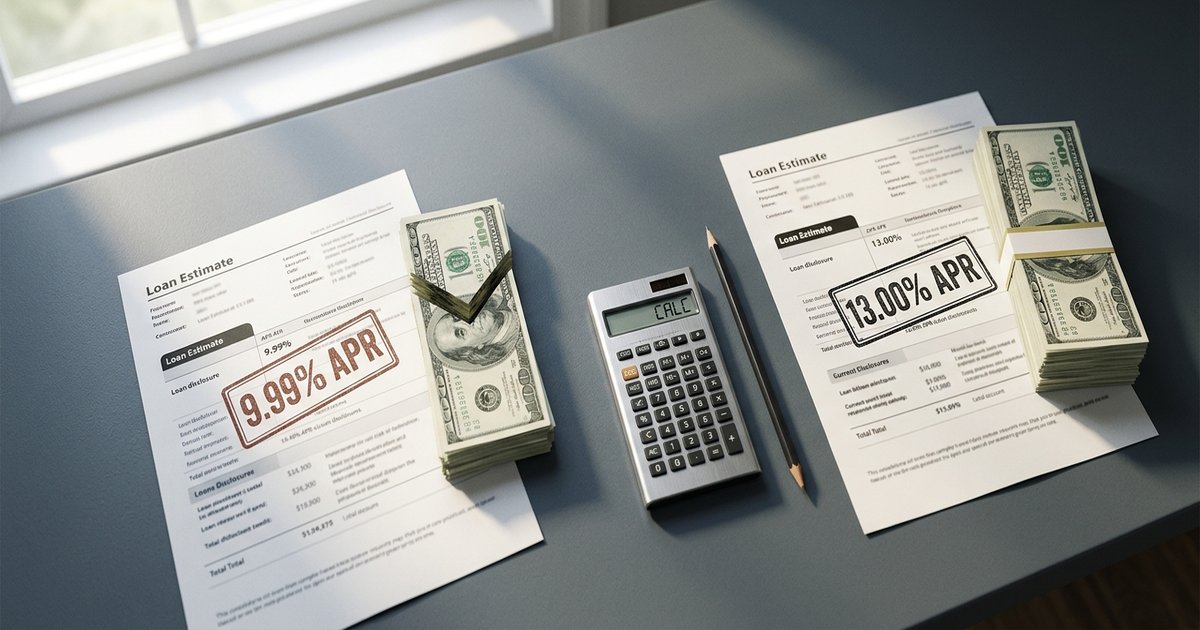
A debt consolidator with a 668 FICO has two prequalified offers in front of him. Offer one: 9.99% APR with a 6% origination fee. Offer two: 13% APR with no fee. Both are 36-month loans for $20,000. Both lenders advertise the lower-rate loan as, well, the lower-rate loan. Run the math and the 13% loan is $459 cheaper over the life of the deal.
That is not a clever trick. It is what happens when you read the disclosure box instead of the marketing page.
Why a 9.99% loan can cost more than a 13% loan
Origination fees are not added to your monthly bill. They are deducted from the loan proceeds before the lender sends you the money. Ask for $20,000 with a 6% origination fee, and the lender disburses $18,800. You still owe interest on $20,000. You are paying interest on $1,200 you never received.
The Truth in Lending Act requires that origination fees be reflected in the disclosed APR, which is why the TILA APR on a 6% fee, 9.99% interest rate loan comes out higher than the headline interest rate the marketing copy promotes. The trouble is that the marketing pages frequently lead with the rate, not the APR. Borrowers comparing a fee loan against a fee-free loan on the basis of headline rates are comparing the wrong numbers. Our piece on how to read the TILA disclosure box walks the federal box.
How origination fees are actually charged
Three things happen mechanically when a fee-bearing loan funds.
- The lender approves you for a stated principal: $20,000.
- The lender deducts the origination fee from the disbursement: $20,000 minus 6% equals $18,800 in your account.
- The lender amortizes the full $20,000 across your monthly payments. You repay principal and interest on $20,000, even though only $18,800 ever hit your account.
If you actually need $20,000 to clear your card balances, you have to borrow more to compensate. To net $20,000 with a 6% fee, you need a $21,277 loan. Now you are paying interest on $21,277.
A worked $20,000 example
Set up the comparison cleanly. Same borrower, same 36-month term, same $20,000 of cash needed.
Offer 1: 9.99% APR (stated), 6% origination fee deducted from proceeds.
- Borrow $21,277 to net $20,000 after the fee.
- Monthly payment on $21,277 at 9.99% over 36 months: about $686.55.
- Total of payments: about $24,716.
- Cost above the $20,000 received: about $4,716.
Offer 2: 13% APR (stated), no origination fee.
- Borrow $20,000, receive $20,000.
- Monthly payment on $20,000 at 13% over 36 months: about $673.79.
- Total of payments: about $24,257.
- Cost above the $20,000 received: about $4,257.
The 13% loan is roughly $459 cheaper over three years, despite carrying a stated rate three full points higher than the 9.99% loan. The lower headline number lost. The math won.
Where the $459 difference comes from
You are paying 9.99% interest on $1,277 of phantom principal you never received. That phantom principal accrues interest for 36 months. The interest cost on the extra $1,277 is just enough to overtake the three-point APR gap on the smaller (real) principal in the no-fee loan. Term length is the lever. Stretch the comparison to 60 months and the gap narrows because the fee gets amortized over more months. Shorten to 24 months and the fee becomes brutal.
Origination fee ranges across major 2026 lenders
As of mid-2026, the personal loan market has split cleanly between fee-charging and no-fee lenders. The published ranges:
- SoFi: 0% to 7%, optional, set during pricing.
- Upstart: 0% to 12%, the widest fee band in the market.
- Best Egg: 0.99% to 9.99%.
- Upgrade: approximately 5%, less variance than peers.
- Prosper: 1% to 9.99%.
- LendingClub: up to 8%.
- Happy Money: 0% to 5%.
- LightStream, Discover: no origination fee.
Two structural notes worth holding onto. First, lenders that charge a fee usually set it inside the same risk-based pricing model that sets your APR, so a borrower at the bottom of the lender's credit band tends to see both a higher rate and a higher fee at once. Both dials turn together. Our piece on why two lenders quote you wildly different APRs on the same day covers the spread between lenders. Second, the fee ranges shift, and the lender's own disclosure page is the only authoritative source on the day you apply.
The breakeven rule of thumb
A 5% origination fee on a 12-month loan adds roughly 8 to 10 percentage points to the effective APR. The same fee on a 60-month loan adds 2 to 3 points. The same fee on a 36-month loan, like our example, adds about 3 points to APR.
That gives you a workable rule. For a 36-month loan, every 1% of origination fee is worth about half a point of APR. For a 60-month loan, it is closer to a third of a point. So a 13% no-fee 36-month loan compares against a 10% fee-bearing loan with a 6% fee on roughly equal terms. Anything below 10% on the fee-bearing side wins. Anything above loses.
Term length matters more than people think
A 6% origination fee on a 24-month loan adds about 6 points of effective APR. The same 6% fee on a 60-month loan adds about 2.4 points. If you are being pushed toward a shorter term to "save on interest," and the loan carries a fee, run the comparison both ways. Sometimes the longer term with the same fee is genuinely cheaper.
A short formula for any two offers
If you want to do this in your head, multiply the fee percentage by 24, then divide by the term in months. The result is a rough estimate of how many APR points the fee adds. A 5% fee on a 36-month loan: 5 times 24 divided by 36 equals about 3.3 points. Add that to the stated rate and you have a back-of-envelope effective rate to compare against the no-fee offer.
Better still: use the TILA APR on the disclosure box. That is the regulator's version of the same calculation, and it is binding.
Reading the TILA disclosure box in 30 seconds
Every personal loan offer comes with a TILA disclosure under Regulation Z. Four lines tell you everything (our piece on five personal loan numbers that decide whether a loan is worth taking uses these as the comparison framework):
- Annual Percentage Rate (APR). This includes finance charges, including origination. Compare APR to APR across offers.
- Finance Charge. Total dollars of interest plus fees over the life of the loan.
- Amount Financed. What the lender actually disburses to you. If this is less than what you applied for, fees were deducted.
- Total of Payments. Sum of all your monthly payments. The total dollar cost.
If the marketing page says 9.99% and the disclosure box APR says 13.6%, the disclosure box wins. Always.
When a fee loan is still the right call
Two situations where the fee-bearing loan is genuinely the better answer.
First, when a borrower with a thin or damaged file cannot get approved by the no-fee lenders at all. LightStream and Discover have higher credit floors than Upstart or Best Egg. If the alternatives are a fee-bearing personal loan at 18% effective APR or a credit card cash advance at 30% with daily compounding (and no grace period), the personal loan is still the better call. The right comparison there is loan vs no loan, not loan vs better loan. (See personal loan vs payday loan true cost for the dollar walkthrough.)
Second, when the fee-bearing loan offers a structural feature the no-fee loan does not (such as direct payoff to credit card issuers in a debt consolidation product, or longer terms). Some borrowers value the discipline of a lender wiring funds directly to Chase and Capital One rather than dropping cash in their checking account. That is a real, if soft, benefit. (For the consolidation playbook, see our $24,000 case study.)
Why this matters for your borrowing decision
Debt consolidation is the use case for more than 66% of approved personal loans in Credible's marketplace data. That means most readers comparing offers right now are doing exactly the kind of comparison that origination fees are designed to obscure. Read the APR, not the rate. Read the amount financed, not the loan amount. And run the total of payments side by side. The answer will not be the headline number on the marketing page about half the time.
Frequently Asked Questions
Are origination fees included in the APR?
Yes. Under TILA and Regulation Z, origination fees are part of the finance charge and must be reflected in the disclosed APR. The interest rate alone does not include the fee, which is why APR and interest rate often differ on fee-bearing loans.
Can I pay the origination fee out of pocket instead of having it deducted?
A few lenders allow this; most do not. The default mechanic is deduction from proceeds, which means you net less than you applied for.
What is a typical origination fee in 2026?
Documented ranges run from 0% (LightStream, Discover) to 12% (Upstart top tier). Best Egg, Prosper, and LendingClub commonly charge 5% to 9% on borrowers in the middle of their credit band. Upgrade is typically about 5%.
Does a higher fee always mean a worse deal?
No. Compare APR to APR and total of payments to total of payments. A higher fee with a much lower interest rate can win on long terms. A lower fee with a higher rate can win on short terms. The numbers tell you, not the structure.
How do I find the actual amount I will receive?
Look at the "Amount Financed" line on the TILA disclosure. That is what the lender will disburse after any fee deduction. If you need a specific amount in hand, you may need to apply for slightly more to compensate for the fee.
Are there reputable no-fee lenders for borrowers with mid-600s credit?
Discover and most federally chartered credit unions do not charge origination fees and lend to mid-600s applicants. SoFi often waives the fee for stronger files. Approval depends on the lender's full underwriting view, not just FICO.