

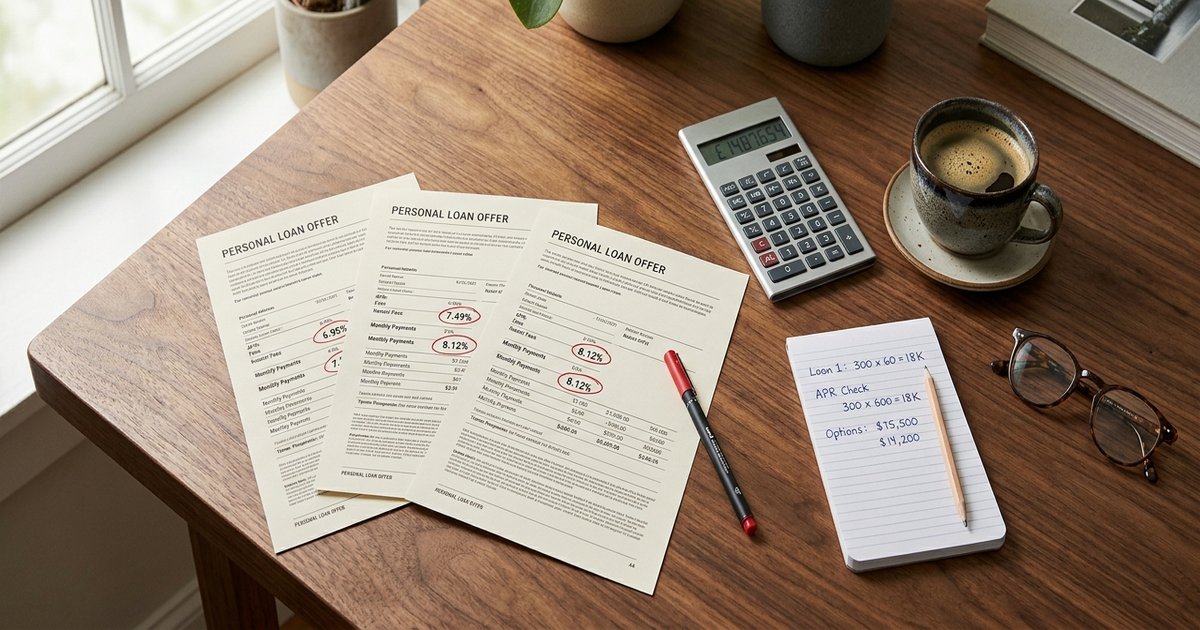
You've got three offers open in three browser tabs, the lender that called you twice yesterday is asking when you'll decide, and every page is showing you a different "best rate" claim with a different fee structure. You've maybe got 48 hours before one of those offers expires. And every "how to compare personal loans" article you've read lists 12 things to check.
You don't have time for 12 things. You have time for five. So that's what we're going to do here. Five numbers, in priority order, with the math written out, and a worked example at the end where the lowest-rate offer turns out to be the most expensive one. By the time you finish reading, you'll have a one-page framework you can use again the next time you're in this seat.
The five numbers, in priority order
- APR (not the interest rate)
- Origination fee
- Total dollars repaid
- Monthly payment as a percent of take-home pay
- Prepayment terms
Now let's break each one down.
Number 1: APR (not the interest rate)
Lenders advertise an interest rate. The legally binding number you actually owe is the annual percentage rate (APR), which the Truth in Lending Act (TILA, Regulation Z) requires every lender to disclose. The difference matters: APR includes the interest rate plus origination fees and other prepaid finance charges expressed as an annualized cost. Interest rate alone doesn't.
So when you see a marketing page advertising a "starting at 8.99% rate" and the disclosure box on your offer says "11.42% APR," you're not being scammed. You're seeing the difference between the rate and the rate-with-fees. The 11.42% is the number to compare against other lenders. Our piece on how to read a personal loan disclosure box walks the federal box line by line.
For 2026, here's the APR landscape across credit profiles, drawn from Bankrate's monthly tracker, NerdWallet's rate roundups, and Credible's weekly trend data:
- Prime credit (740+): 8% to 12%
- Near-prime (670 to 739): 12% to 18%
- Fair credit (580 to 669): 18% to 25%
- Subprime (under 580): 27% to 35.99% (35.99% is the cap at most major fintech lenders)
If you're being quoted an APR meaningfully above your credit tier's range, that's a sign to keep shopping. Our breakdown of why two lenders quote you wildly different APRs on the same day covers what's behind the spread.
Number 2: Origination fee
An origination fee is a one-time charge the lender deducts for setting up the loan. The range across major lenders, per their own published disclosure pages:
- SoFi: 0%
- LightStream: 0%
- LendingClub: 0% to 8%
- Upstart: 0% to 12%
- Best Egg: 0.99% to 9.99%
- Avant: up to 4.75%
- Upgrade: 1.85% to 9.99%
Here's the part most borrowers miss. Origination is almost always deducted from the disbursed amount, not added to the balance. So if you take a $20,000 loan with a 5% origination fee, the lender wires you $19,000 but you repay $20,000 plus interest. You're paying interest on the full $20,000 even though only $19,000 hits your account. Our piece on the hidden origination fee math shows why this can flip the ranking of two offers.
This means two things. First, if you actually need $20,000 in your hand, you have to size your loan request up: $20,000 / (1 - 0.05) = $21,053 to receive $20,000 net. Second, an origination fee can flip the ranking of two offers. A 10% APR loan with a 6% origination fee costs more than a 12% APR loan with no fee on most short to medium terms.
One quirk to verify: a few lenders add the origination to the balance instead of deducting it. The TILA disclosure on your offer will tell you which approach the lender uses. Check before you accept.
Number 3: Total dollars repaid
This is the single most useful comparison number, and the one most borrowers don't actually compute. Total dollars repaid equals principal plus all interest paid plus all fees over the full life of the loan.
Lenders are required to show this number on the TILA disclosure, sometimes labeled "Total of Payments." If you can find this single figure on each of your offers, the comparison gets stupidly simple: lower number wins, holding everything else equal.
The reason it's so powerful is that it collapses APR, term, and origination fee into one figure. A 7-year loan at 9% APR can have a total of payments larger than a 5-year loan at 12% APR, even though the longer loan has a lower rate. The shorter loan pays back faster, so less interest accrues. Total dollars repaid catches that. APR alone doesn't.
Number 4: Monthly payment as a percent of take-home pay
The monthly payment is the number you live with for the next two to seven years. If it's too big, the loan that looked great on paper becomes the loan you skip when rent goes up.
The general guideline (used in CFPB consumer education and reflected in Fannie Mae's debt-to-income guidance for mortgages) is that unsecured installment debt should not exceed roughly 10% to 15% of your monthly take-home pay. Take-home means after taxes, not gross. Some financial planners recommend 8% as a more conservative ceiling.
Run the math. If your monthly take-home is $4,500, the 10-15% guideline puts your sustainable personal loan payment at $450 to $675. A monthly payment above 20% of take-home is a red flag, especially if you're carrying other debt.
This number matters even more if you're using the loan for debt consolidation. The whole point of consolidation is reducing pressure on monthly cash flow, not just reducing total interest. A consolidation loan with a lower APR but a higher monthly payment than what you're currently sending out misses the point. Our $24,000 credit card payoff case study walks an example.
Number 5: Prepayment terms
If you make extra payments or pay the loan off early, what happens?
Most major fintech personal loan lenders don't charge prepayment penalties. SoFi, LightStream, Marcus, Discover, Upstart, and most credit unions explicitly don't. But federal law doesn't ban them, and some smaller lenders do. The TILA disclosure must state whether a penalty applies.
Two questions to ask:
- Is there a prepayment penalty? If yes, walk away or factor the penalty into your total cost.
- How does the lender allocate extra payments? If you send an extra $200, does it go to principal (good) or just toward future interest (much less helpful)? Most lenders apply extras to principal, but you sometimes have to specify "apply to principal" in the memo or in the lender's portal. Confirm before you start sending extras.
Why does this matter for an offer you might never prepay? Because life changes. Bonuses happen. Tax refunds happen. The freedom to retire a loan early without penalty is worth real money over a multi-year term.
A worked example: three offers on a $15,000 loan, 48 months
Imagine a near-prime borrower (FICO 690) shopping a $15,000 personal loan over 48 months. Three offers come in:
Offer A: 11.5% APR, 6% origination fee. The 11.5% is the marketing rate plus the fee, so the disclosed APR after the fee is closer to 14.8%. You receive $14,100 in your account ($15,000 minus the $900 fee), but you repay on $15,000 principal. Monthly payment: about $391. Total of payments: about $18,768. Net cash received: $14,100. Net cost: $4,668.
Offer B: 13.5% APR, no origination fee. What you see is what you get. You receive the full $15,000. Monthly payment: about $407. Total of payments: about $19,536. Net cash received: $15,000. Net cost: $4,536.
Offer C: 12.75% APR, 0.5% autopay rate discount, no origination fee. Effective APR with autopay: 12.25%. You receive the full $15,000. Monthly payment: about $396. Total of payments: about $19,008. Net cash received: $15,000. Net cost: $4,008.
Notice what happened. Offer A had the lowest advertised APR. It also had the highest net cost ($4,668), and you got $900 less cash to actually use. Offer C has a higher headline rate than A but the lowest total cost because there's no fee and the autopay discount lops half a point off.
This is what "the lowest rate isn't always the cheapest loan" actually looks like in dollars.
A quick-reference table you can save
For each offer in front of you, fill in these five numbers:
- APR (from the TILA disclosure, not the marketing page)
- Origination fee ($ amount and % of loan)
- Total of payments (the number that actually decides)
- Monthly payment / monthly take-home (express as %)
- Prepayment penalty (yes/no) and extra-payment allocation rule
Lowest "Total of payments" with a monthly payment under 15% of take-home and no prepayment penalty wins, almost every time.
When to walk away
Red flags that show up in any of the five numbers:
- APR over 35.99%. Most reputable fintechs cap at this rate. Anything higher and you're outside the mainstream personal loan market.
- Origination fee above 10%. Fee structures that aggressive eat too much of your loan to be worth it for most borrowers.
- Monthly payment above 20% of take-home pay. The math may work on paper. The cash flow won't.
- A prepayment penalty disclosed in the TILA box. Most major lenders don't charge one.
- The disclosed APR is significantly higher than the headline rate, with no clear fee explanation. That's a paperwork mismatch worth a phone call.
If the offer feels off entirely, our piece on how to spot a personal loan scam walks the structural warning signs.
Where to find each of these numbers
Always read the TILA disclosure box, also called the "Truth in Lending disclosure" or "Federal Truth in Lending Disclosure Statement." Lenders are legally required to provide this before you sign, and it contains all five numbers in standardized format. The marketing page on the lender's website is for reference; the TILA disclosure is the contract.
If you can't easily find the disclosure for an offer in front of you, ask. A lender that won't show you the disclosure before you commit is a lender to walk away from.
One closing reminder. The five-number framework is a comparison tool, not a substitute for prequalifying with multiple lenders. Run prequalifications at three to five places (most use a soft pull, no credit impact, see our rate-shopping guide) and apply the framework to whatever comes back. Trust Point Loans isn't a lender, and we don't set rates. Our role is connecting you to options that fit your situation. The five numbers are how you decide which option earns your signature.
Frequently Asked Questions
What's the difference between APR and interest rate on a personal loan?
Interest rate is the cost of borrowing the principal, expressed annually. APR includes the interest rate plus origination fees and other prepaid finance charges, expressed as an annualized cost. APR is the legally required figure on the TILA disclosure.
How do I know if my origination fee is reasonable?
Major fintech ranges run from 0% (SoFi, LightStream) to as high as 12% (Upstart's top end). For prime credit, expect 0% to 3%. For near-prime and fair credit, 3% to 8% is common. Anything above 10% should make you pause and shop more.
Should I always pick the loan with the lowest monthly payment?
Not usually. Lower monthly payments often come from longer terms, which means more total interest paid. Total dollars repaid is the more useful comparison. Pick the lowest total payments figure that still keeps your monthly payment under 15% of take-home pay.
What's the maximum legal APR on a personal loan?
There's no federal cap, but most major fintech lenders cap at 35.99%. Federal credit unions cap at 18% under NCUA rules. Some states impose their own usury caps; California, New York, and others restrict rates above certain thresholds.
Will a prepayment penalty show up clearly on the offer?
Yes. TILA requires the disclosure to state whether a prepayment penalty applies. If the box says "no" or is left blank where prepayment is concerned, you can pay the loan off early without extra cost.
How much of my take-home pay should go to a personal loan?
The general guideline is 10% to 15% of monthly take-home pay for unsecured installment debt outside of housing. Some financial planners recommend keeping it under 8%. Above 20% is a stress point, especially if you're carrying other debt.