

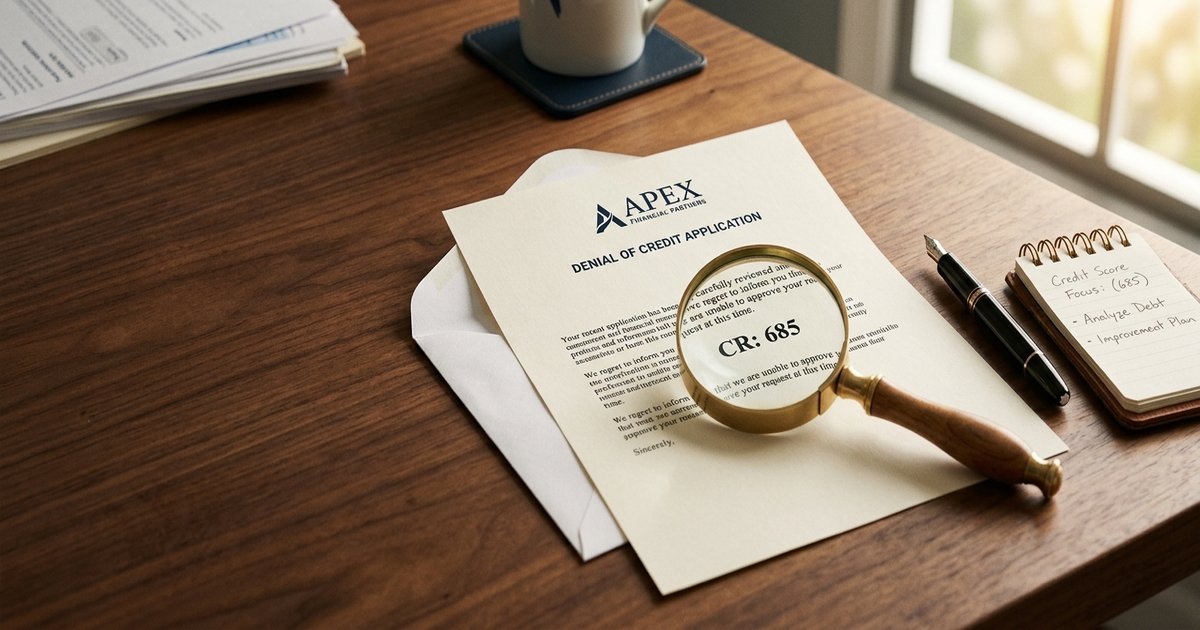
The letter usually arrives in a thin envelope, three or four short paragraphs, often printed on the back of the lender's logo letterhead. The borrower I spoke with last fall opened hers, read "we are unable to approve your application at this time," and threw it in a drawer. She reapplied at two other lenders the next week, got denied again, and assumed her credit was just bad.
The letter she threw away contained the most useful free document she would receive that month. Federal law calls it an adverse action notice. It is the lender's regulatory obligation under the Equal Credit Opportunity Act and the Fair Credit Reporting Act, and it is built to tell you exactly why you were denied, what your credit score was, which credit bureau the lender pulled, and how to get a free copy of your report. Most denied borrowers don't read it. They should.
The letter is a diagnostic, not a verdict
A denial means this lender, with this scorecard, on this day, said no. It does not mean every lender will. Our companion piece on why two lenders quote you wildly different APRs on the same day walks through exactly why one model can decline a file another will fund. The adverse action notice is the document that tells you which specific factors drove the decision so you can target them before the next application. Used correctly, it shortens the path to approval. Used incorrectly (thrown in a drawer), it makes the next denial more likely.
Two federal statutes drive what has to be on the page. ECOA's implementing rule, Regulation B at 12 CFR 1002.9, requires the notice itself and the reasons. FCRA section 615(a), codified at 15 USC 1681m, layers on the credit-report and credit-score disclosures. A single letter usually satisfies both, but the content requirements stack.
The five things every adverse action notice must contain
Under ECOA Reg B and FCRA section 615(a), the notice must include:
- A statement of the action taken (in plain English, "your application has been denied").
- The specific principal reasons for the action, up to four. ECOA explicitly requires specificity (12 CFR 1002.9(b)(2)).
- The name, address, and toll-free phone number of the consumer reporting agency that supplied the report, plus a statement that the CRA did not make the decision and cannot explain it.
- Notice of your right to a free copy of your credit report from that CRA within 60 days, separate from your annual free report.
- If a credit score was used, the score itself, the range of possible scores, the date the score was created, the name of the entity that produced the score, and up to four key factors that adversely affected the score.
If your letter is missing any of those elements, the lender is non-compliant. That is not a small thing. The CFPB and FTC have brought enforcement actions on inadequate adverse action content; the CFPB's enforcement docket is searchable, and recent consent orders have hit large banks and fintechs alike.
Why "did not meet our standards" is not a legal answer
The single most common borrower complaint I see in this area is some version of: "the letter just says I didn't meet their internal score threshold." That is not a compliant statement of reasons under ECOA.
Reg B 1002.9(b)(2) requires the principal reasons to be specific and to "indicate the principal reason(s) for the adverse action." Generic statements that the applicant failed to score high enough on the lender's internal model do not meet that standard. The Federal Reserve's compliance guidance is explicit that vague or boilerplate reasons are insufficient. If you got one, write back and ask for a more specific statement of reasons. Cite the regulation by section. Most compliance teams will produce a better letter rather than risk a CFPB complaint.
The four principal reasons rule, decoded
Lenders may list up to four principal reasons. Some list fewer if fewer were determinative. The reasons usually come from a small library of standardized factor codes used by FICO and VantageScore. Here is what the most common ones actually mean.
"Too few accounts currently paid as agreed." The lender's model wanted to see more positive trade lines reporting on time. Fix: open one or two accounts that report monthly (a secured card, a credit-builder loan), pay them on time, let them age six to twelve months.
"Delinquent past or present credit obligations." Either you have a current late payment or you have late payments inside the model's lookback window (usually 24 to 36 months). Fix: bring everything current immediately and, if you have a recent late, wait it out. Late payments fall off after seven years under FCRA, but the score impact decays much faster.
"Length of credit history is too short." The average age of your accounts is below what the model wants. Fix: do not close old cards. Becoming an authorized user on a long-standing account can help, depending on the scorecard.
"Amount owed on revolving accounts." Your utilization is too high, often above 30% of your limits, sometimes 10%. Fix: pay down balances before the statement closes (the statement-date balance is what gets reported, not the due-date balance). Our piece on three credit score moves that actually work in 60 days walks the timing.
"Derogatory public record or collection." A judgment, tax lien, charged-off account, or third-party collection is on file. Fix: pull your report, identify the item, dispute it if inaccurate, negotiate a pay-for-delete if not.
The credit score disclosure: how to read your number
FCRA section 615(a) requires the lender to disclose the actual score used, not just a generic FICO. The score might be a FICO 8, a FICO 9, a VantageScore 4.0, or a custom model the lender built. The notice will name it.
The "range of possible scores" matters because not every model uses 300 to 850. Some industry-specific FICO variants run 250 to 900. If your notice says you scored 612 with a range of 300 to 850 and four factors that hurt you, you have everything you need to triangulate: your number, where it falls in the distribution, and what to fix.
If you applied at three lenders and got three different scores, that is normal. Each lender may pull a different bureau, run a different model, or weight factors differently. All of the scores are real. They reflect different scorecards, not different truths.
The 60-day free credit report and how to use it
Within 60 days of receiving an adverse action notice, you have the right under FCRA to a free copy of the credit report from the CRA named in the letter. This is in addition to your annual free reports at AnnualCreditReport.com, not in place of them.
Pull the report immediately. Compare every line to the four reasons listed on the notice. Do you see a collection you already paid? A late payment that wasn't yours? A trade line that should have aged off? Each of those is a candidate for dispute.
The dispute process under FCRA section 611
If you find an inaccuracy, file a written dispute with the credit reporting agency. Do it in writing, keep a copy, and send it certified mail or through the bureau's online dispute portal (which generates a confirmation). FCRA section 611 requires the bureau to investigate within 30 days, contact the furnisher (the lender or collector that reported the item), and either verify, correct, or delete the item.
One borrower I corresponded with disputed a $312 collection that had already been paid. The bureau deleted it in 28 days. Her next personal-loan application, six weeks later, was approved. The dispute did not magically rebuild her credit; it removed a single inaccurate item that was suppressing her score.
If the bureau verifies an item you still believe is wrong, you have the right to add a 100-word consumer statement to your file, and you can dispute again with new evidence. Persistent inaccuracies that the bureau refuses to correct are CFPB complaint territory.
When to file a CFPB complaint and what happens after
File a CFPB complaint at consumerfinance.gov/complaint when:
- The adverse action notice is missing required elements.
- The reasons given are too vague to satisfy ECOA Reg B specificity.
- A bureau refused to investigate a dispute or verified an item without evidence.
- A lender continued to report a discharged or inaccurate debt after you raised the issue.
The CFPB forwards the complaint to the company, which generally responds within 15 days. The complaint and response are added to the public database. Filing does not guarantee resolution, but it raises the issue inside the company's compliance function, where it gets attention it would not otherwise receive.
Discrimination flags: when a denial may not be about your file
ECOA at 15 USC 1691 prohibits credit decisions based on race, color, religion, national origin, sex, marital status, age, receipt of public assistance income, or your exercise of rights under the Consumer Credit Protection Act. If the reasons in your notice do not match what you see on your credit report, or you have evidence the lender treated you differently from a similarly-situated applicant, that is a fair-lending issue, not just a credit issue.
Document the application carefully. File with the CFPB and, where applicable, the Department of Justice or HUD (for housing-secured credit). Statutes of limitations are real: FCRA private actions run two years from discovery and five years from the violation; ECOA runs five years.
The 30-day reapplication plan
Once you have the notice, the report, and a clear list of fixable items, the next move is a sequence, not a sprint. Our 14-day pre-application sprint compresses the same steps for borrowers on a tight timeline.
- Days 1 to 7: pull the free credit report from the CRA named in the notice. Map every reason on the letter to a line on the report.
- Days 7 to 21: dispute every inaccuracy under FCRA 611. Pay down revolving balances to under 10% of limits before the next statement closes. Bring any current delinquency to current.
- Days 21 to 30: do not apply for new credit. Each hard pull dings the file. Let your fixes report.
- Day 30 and after: prequalify (soft pull only) at two or three lenders before submitting a formal application. Our piece on rate shopping without hurting credit covers the 14-day window for personal loans specifically.
The borrower who threw her notice in the drawer eventually pulled it back out, found two inaccuracies, disputed them, paid down a card, and got approved at her third attempt eight weeks later. The letter did the work. She just had to read it.
Frequently Asked Questions
What is an adverse action notice on a personal loan denial?
It is the written notice a lender must send when it denies your application or offers worse-than-applied-for terms. ECOA Reg B (12 CFR 1002.9) and FCRA section 615(a) require it to include the specific reasons (up to four), the credit reporting agency used, your right to a free credit report within 60 days, and, if used, your credit score with range and key factors.
How long does the lender have to send the notice?
Reg B requires notification within 30 days of receiving a completed application or 30 days of taking adverse action on an existing account. If you have not received it within 30 days, contact the lender in writing and, if needed, file with the CFPB.
Can I get a more specific reason if my notice is too vague?
Yes. ECOA requires specificity. A generic "did not meet internal standards" is not compliant. Write to the lender citing 12 CFR 1002.9(b)(2) and request a specific statement of principal reasons.
Is the free credit report after a denial different from my annual free report?
Yes. The 60-day report under FCRA section 615(a) is in addition to the annual free report under 15 USC 1681j. You are entitled to both, from the CRA named in the adverse action notice.
What if the reasons on my notice point to items I think are inaccurate?
Pull the report, file a written dispute with the bureau under FCRA section 611, and keep records. The bureau has 30 days to investigate, contact the furnisher, and verify, correct, or delete the item.
Should I reapply right away after a denial?
Generally no. Fix the documented reasons first, let your changes report, and prequalify (soft pull) before any new hard pull. Multiple personal-loan inquiries within a 14-day FICO rate-shopping window count as one, but a denial-followed-by-denial pattern hurts more than it helps.