

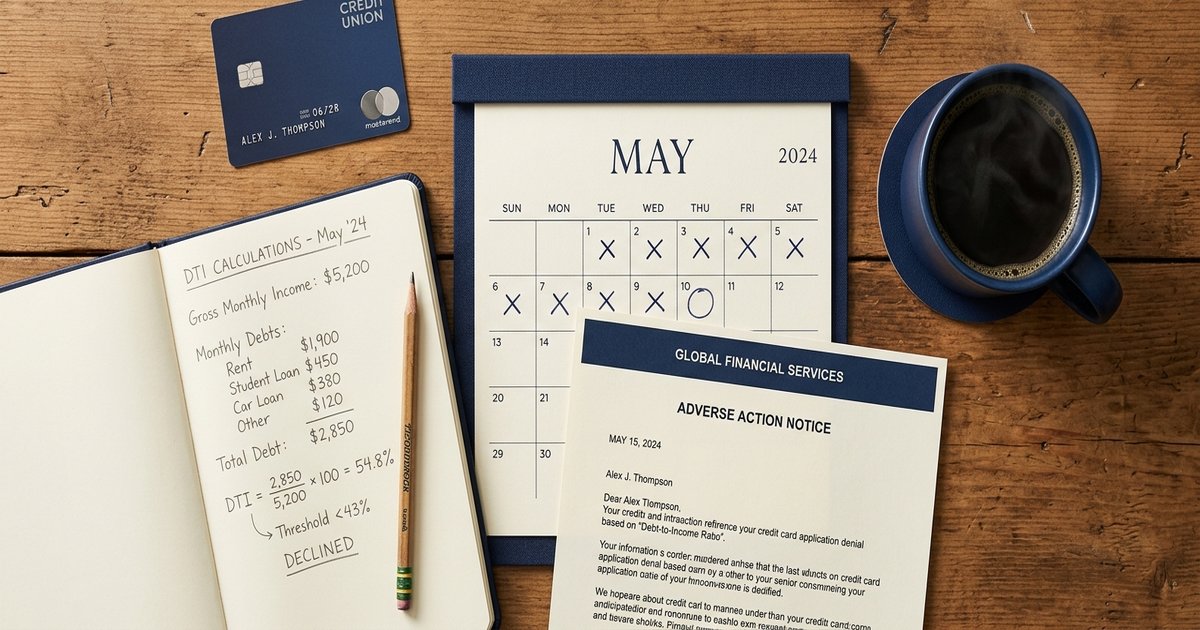
You got declined. Now you are sitting there with a denial letter, a bruised credit file, and the urge to fire off another application before the week is out. Don't do it. The two weeks sitting between you and your next attempt are the single highest leverage window you have, and most people waste it.
This is a day-by-day plan to use that window the way an underwriter would want you to use it. No magic. No promises. Just the moves that actually shift a borderline file across the approval line at a second lender.
Why the two weeks before you apply matter more than the six months before
I have watched borrowers spend half a year "working on their credit" and then torch the whole project in the final week with a fresh hard pull, a new card, or a balance that reported the day before they hit submit. Underwriters do not read the last six months of your file as a story. They look at a snapshot. The snapshot they pull is the one your bureaus generate the day they pull it. So the 14 days right before that pull matter in ways the prior six months do not.
FICO weights the score like this, straight from myFICO's published factor breakdown: payment history 35%, amounts owed 30%, length of credit history 15%, credit mix 10%, new credit 10%. Two of those five buckets, amounts owed and new credit, can move meaningfully inside two weeks. The other three cannot. So your sprint is going to focus where the leverage actually lives.
Day 1 to 2: Read the denial letter like a roadmap
Your adverse action notice is not a rejection slip. It is a free, federally mandated cheat sheet, and you are throwing it away if you stuff it in a drawer. If you want the full anatomy of that letter, our piece on your rights under the FCRA when a lender denies you walks through it line by line.
What ECOA requires the letter to tell you
Under the Equal Credit Opportunity Act (Reg B, 12 CFR 1002.9), the lender has 30 days from a completed application to send you a denial notice with the specific reasons they declined you. You have 60 days from that notice to request a written explanation if the one you got was vague.
What the four FCRA factors actually mean
The Fair Credit Reporting Act requires the notice to include up to four key factors that adversely affected your score. They look generic ("amounts owed on revolving accounts," "too many recent inquiries"), but each is a hint about which bucket sank you. Lenders cannot use boilerplate factors that fail to identify the actual reason. If the letter says "ratio of revolving balances to credit limits," the lender is telling you out loud that your utilization is the problem. Believe them.
On Day 1, copy those four factors onto a sticky note. They are your priority list for the next 13 days.
Day 3 to 5: Pull all three credit reports and triage
FCRA gives you a free copy of the report the lender used in the denial within 60 days, plus weekly free reports from each bureau at AnnualCreditReport.com (the only federally mandated site). Pull all three. Equifax. Experian. TransUnion. They do not match. They never match.
What you are looking for in this triage:
- Accounts you do not recognize.
- Collections marked open that you already paid.
- Late payments that were never late.
- Balances that report higher than what your card statement actually shows.
- Old addresses or names tied to someone else's file mixed into yours.
If you find a clear error, file the dispute online with that bureau on Day 4 or Day 5. Bureaus have 30 days to investigate, but in my experience clean errors come off in seven to fifteen days. Do not dispute things that are accurate but unflattering. That is a different game and a longer one.
Day 6 to 9: The statement-close utilization play
This is the move nobody told you about. It is also the one that moves the needle fastest.
Why paying on the due date is too late
Card issuers report your balance to the bureaus on the statement closing date, not the payment due date. Federal regulation requires at least a 21-day gap between statement close and the due date. So you can pay your bill in full every month, on time, and still report 70% utilization to the bureaus, because the balance they see is the one that existed the day the statement cut.
High-FICO files (760+) typically run utilization under 10% on each card and overall. That is the target. Not zero, just low. Our companion guide on three credit score moves that actually work in 60 days walks through the timing in more detail.
A worked example on a $4,000 card limit
Say you have a card with a $4,000 limit. You charged $2,800 this cycle and you usually pay it off the day before the due date. Statement closes on the 12th. Due date is the 5th of the following month.
If you wait until the 4th to pay, the bureau already saw $2,800 reported on the 12th. That is 70% utilization. Score impact: ugly.
If you pay $2,500 of that balance on the 10th, before the statement cuts on the 12th, the bureau sees $300 reported. That is 7.5% utilization. Same money, same month, completely different score input.
On Day 6, log into every card and write down its statement closing date. On Day 7 through Day 9, pay each card down to a target of 1% to 9% of its limit before that date hits. Do not pay them to zero on every card. A small reported balance on at least one card is fine, sometimes preferred.
Day 10 to 12: Run the DTI math the underwriter will run
Most personal loan lenders cap accepted debt-to-income at 50%. Many prefer below 36%. The Federal Reserve's G.19 Consumer Credit release tracks where average rates and balances sit across the bank channel.
DTI is monthly debt obligations divided by gross monthly income. Underwriters use the minimum payment on each revolving line, not the full balance. So a $9,000 card balance with a $225 minimum hits your DTI at $225, not $9,000.
Take an hour on Day 10. List every recurring debt obligation: rent or mortgage, car payment, student loans (use the IBR amount if you are on income-driven), card minimums, child support, alimony. Add them up. Divide by your gross monthly pay. If you are over 45%, the loan you want is going to be tough to land at a normal lender. If you are at 38%, you have room.
Day 11 and 12 are about reducing the front-end number. Pay one small card to zero so its minimum payment vanishes. Refinance a private student loan if the new minimum is meaningfully lower. Don't do anything that requires a hard inquiry.
Day 13: Pick the second lender
Here is where most people repeat their first mistake. They got declined at one big online lender, so they fire an application at the next big online lender that runs the same underwriting model on the same data. Same denial. If you want to understand why two lenders look at the same file and price it 15 points apart, read our breakdown of why two lenders quote you wildly different APRs on the same day.
Put a federally chartered credit union on your short list. Federal credit unions cap personal loan APRs at 18%, which protects you from the worst-case rate, and they often look at relationship banking, direct deposit history, and explanation of recent score drops in ways the algorithmic lenders do not. The NCUA's consumer site has a credit union locator.
One thing to know cold: personal loan inquiries are not bundled by FICO's rate-shopping logic. Mortgage, auto, and student loan inquiries within a 14-day or 45-day window get treated as a single pull. Personal loans do not. Every personal loan hard pull counts separately. So pre-qualify (soft pull) at two or three lenders before you commit to one hard pull. Our piece on soft pull, hard pull, and the quiet cost of rate shopping wrong spells out the windows for each scoring model.
Day 14: The application itself, line by line
By the time you sit down to fill out the application, the work is mostly done. Don't fumble the last mile.
- Use the same legal name on the application as the one on your credit file. Mismatches kick to manual review.
- Report gross income, not net. Include W-2, 1099, and any documented side income you can substantiate.
- If you are a renter, list housing as rent, not "other." Underwriters cross-check.
- Ask for the exact amount you need. Padding the request to "have a little extra" raises your DTI for no reason.
- Pick the longest acceptable term to qualify, then prepay the loan early if your situation allows. Most reputable personal loans have no prepayment penalty under TILA-disclosed terms.
Submit. Then close the laptop. Don't apply anywhere else for at least 30 days.
What not to do during the 14 days
I have seen each of these blow up a clean application in the last 72 hours.
- Do not open a new card. A new tradeline drops your average age of accounts and adds a hard inquiry. Both factors hurt the snapshot.
- Do not run a balance transfer. The new card looks like new credit. The transferred balance often reports near the new limit. You traded one problem for two.
- Do not deposit a large lump from a relative to "show income." Underwriters who look at bank statements ask where it came from. They will not count gifts as income, and the unexplained deposit can read as flagging risk.
- Do not close old cards. Closing the oldest card on file shortens your average age and shrinks your total available credit. Both move the wrong way.
- Do not let a card balance run higher than usual the cycle before applying. Even a one-month spike will report.
What this plan does not promise
I am not going to tell you 14 days will turn a 580 into a 720. It won't. What it will do is take a borderline file, the one that got declined by a hair, and present it cleanly enough that the next lender's algorithm sees a different applicant. Sometimes that is all the difference. Sometimes it is not enough, and the answer is to keep working for another 60 or 90 days. The adverse action letter will tell you which one you are.
Trust Point Loans is not a lender. We connect borrowers with funding options that fit their situation, and we publish guides like this so the next application you submit goes out as strong as you can make it.
Frequently Asked Questions
How long should I wait between personal loan applications after a denial?
At minimum 14 days, ideally 30. Some lenders (Upstart, for example) require 30 days before reapplying with them specifically. The 14-day window is the time you need to fix the issues the denial letter named. Less than that and you are firing the same file at a similar algorithm.
Will paying my credit card down before the statement closes really change my score in two weeks?
It can, because utilization is recalculated every reporting cycle and accounts for 30% of your FICO. The exact point movement depends on the rest of your file, so I won't quote you a number. Direction is reliable. Magnitude varies.
Does pre-qualification count as a hard inquiry?
No. Pre-qualification uses a soft pull and does not affect your score. The hard pull happens when you submit the full application. Use pre-qualification to compare offers from two or three lenders before committing.
If the denial letter says "insufficient credit history," can I fix that in 14 days?
Not really. Length of credit history is 15% of FICO and it moves on a calendar that does not care about your application timeline. What you can do is become an authorized user on a clean, aged account belonging to a parent or partner. The added tradeline reports to the bureaus and can lift the snapshot.
Is a credit union actually a better bet than an online lender?
For borrowers in the fair-credit band, often yes. Federal credit unions cap APRs at 18%, will sometimes review your file manually, and weigh existing relationship data (direct deposit, savings history) that online lenders ignore. They are not faster, and they are not always cheaper at the prime tier, but for a borderline file they belong on the short list.
Can I dispute accurate negative items on my report?
You can, but the bureau will verify them and they will stay. Disputing accurate items is a waste of the 14 days. Save the dispute process for clear factual errors, mixed files, or paid items reporting as open.