

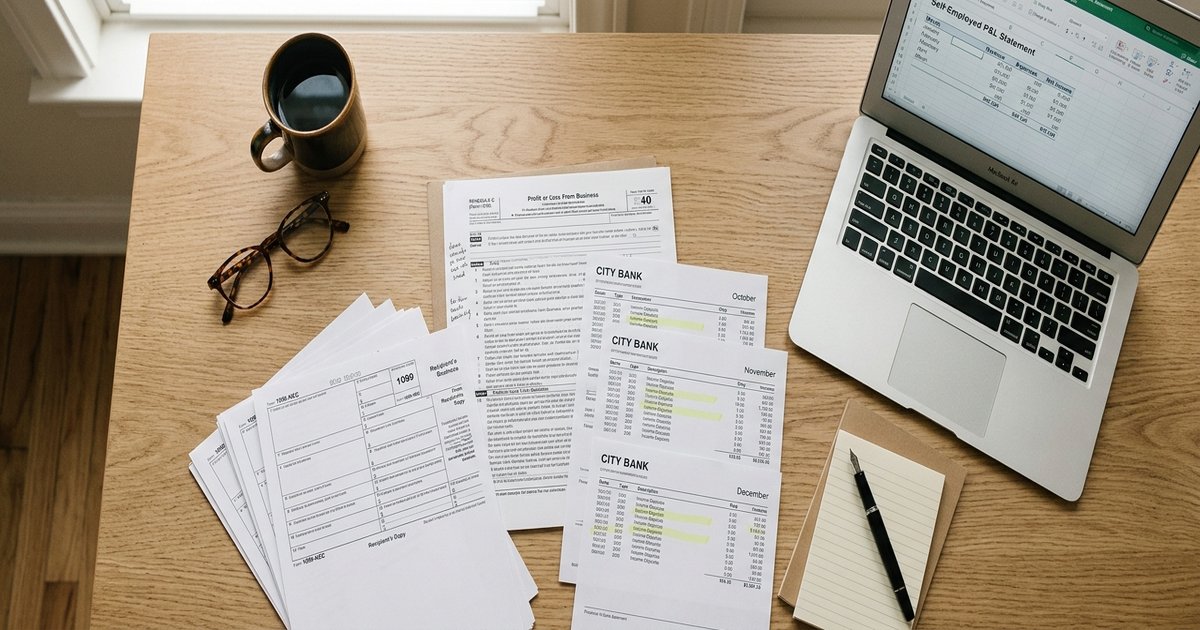
You're three years into running your own thing. The deposits are steady, your FICO is north of 700, and you've finally got the kind of cash flow that lets you sleep at night. So you fill out a personal loan application, list your income, and a week later you get a denial that says "insufficient income documentation." Which is funny, because you sent them a Schedule C and twelve months of bank statements.
If that's where you are right now, I want to walk you through what actually happens behind that denial letter, and what to send next time. Because here's the thing nobody tells self-employed applicants: the underwriter isn't doubting that you make money. They're trying to translate your paperwork into a single number called "qualifying income," and your job is to make that translation easy.
Why self-employed applications get denied more often than your credit file would predict
For a W-2 employee, qualifying income is one number on one document. Pay stub, line 1, done. For a self-employed applicant, the same number has to be reconstructed from three or four different sources, and any one of them missing or inconsistent can sink the file.
Industry analyses have suggested a meaningful approval gap between gig workers and W-2 employees with similar credit scores, and the leading cause is documentation, not creditworthiness. The Federal Reserve's research on loan pricing shows that risk-based pricing also assigns self-employed applicants to higher tiers than W-2 employees with the same credit profile, partly because the income is harder to verify and partly because it's seen as more variable. Our piece on how online personal loan underwriting works walks through the cash-flow layer where self-employed files often get the closest read.
So the goal isn't to argue with that. The goal is to show up with the exact paperwork that makes you look as boring and predictable as a salaried employee.
The four documents underwriters care about
Schedule C and your tax return: net profit, not gross
If you're a sole proprietor, Schedule C of IRS Form 1040 is the document that tells the underwriter what your business actually earned after expenses. This is the one most self-employed applicants get tripped up on, because the line they care about is net profit, not gross revenue.
Imagine you billed $120,000 last year, deducted $70,000 in expenses (home office, mileage, equipment, software, the works), and reported $50,000 in net profit. The underwriter is using the $50,000 figure, not the $120,000.
SoFi spells it out plainly in their support docs: they require both the previous year and the year before that, and the returns must be filed with the IRS. Most major lenders do something similar. They will then average those two years to set qualifying income, mirroring what mortgage underwriters do under GSE guidelines.
A practical implication that catches a lot of freelancers off guard: those aggressive deductions that lower your tax bill also lower your borrowing power. If you wrote off everything humanly possible to pay the IRS less, the lender sees a smaller number too.
1099-NEC and 1099-K: the contractor paper trail
If you're paid as an independent contractor, your clients (or platforms) issue 1099 forms. 1099-NEC covers nonemployee compensation, the standard contractor income form. 1099-K covers payments processed through third-party platforms (Stripe, PayPal, Venmo for business, gig apps).
One thing to know about 1099-K reporting: the IRS has been phasing in a lower threshold. Per the IRS guidance on Form 1099-K, the threshold has been adjusted in recent years, with the eventual target being $600. So if you've been working through Uber, Etsy, DoorDash, or similar platforms, you should be receiving 1099-Ks from them now even for relatively modest income.
Lenders use 1099s as corroboration. If your Schedule C shows $80,000 and your 1099s add up to $78,000, you look consistent. If your Schedule C says $80,000 and you have one 1099 for $20,000 and a stack of bank deposits, you'll be asked for more.
Bank statements: the cash-flow corroboration
Bank statements are the document underwriters use to check whether the income you're claiming actually shows up in your account. SoFi's standard ask for additional verification is three months of statements. Other lenders ask for six or twelve.
What they're looking for:
- Consistent monthly deposits that match the income you claimed
- Few or no overdrafts
- A separation between business deposits and personal spending (this matters more than you'd think)
- No large unexplained transfers in (those look like loans, not income)
If you're depositing client checks into the same account where you're paying the dog walker and your gym membership, the underwriter is doing a forensic exercise to figure out what's revenue. Make their job easy. A separate business checking account, even a free one, is one of the cheapest improvements you can make to your loan application.
Profit-and-loss statements (and when a CPA letter helps)
A profit-and-loss statement (often called a P&L) is a one-page summary of your revenue, expenses, and net income for a recent period, usually year-to-date. Credit unions and community banks ask for these more often than fintechs do.
A CPA letter is a short signed letter from your accountant confirming your business has been operating for X years, your average annual income, and that they've reviewed your books. It's not legally binding, but it's a credibility signal. As one borrower put it on r/Entrepreneur, "My CPA letter mattered more than my bank statements. The credit union officer literally said so."
If you've got a CPA already, ask them. Most will write one for a small fee or for free if you're an existing client.
Document combinations that work, by lender type
Not every lender weighs these documents the same way. Here's how the three big buckets tend to behave.
Bank-funded fintechs (SoFi, LightStream, Discover, similar)
Expect to provide:
- Two years of personal federal tax returns including Schedule C
- Most recent 1099s
- Three months of bank statements
They underwrite to averaged net profit and tend to discount one-time spikes (a freak $40,000 month doesn't help if last year was $50K). They're rigorous, but if your file is clean, they offer some of the best rates available to self-employed borrowers.
Marketplace and AI-driven fintechs (Upstart, Best Egg, Prosper, Upgrade)
These lenders are more flexible on documentation. Several will accept bank-statement-only verification when tax returns are missing or weak. They tend to weight cash-flow patterns heavily: consistent deposits, low overdrafts, healthy average balances.
If your last tax return was rough (because you front-loaded deductions or had a slow year), this is the lender bucket where you have the best shot. One borrower I came across put it this way: "Bank statement loans saved my application. Upstart approved me on twelve months of Chase business statements when SoFi denied me for low net profit."
Credit unions and community banks
These tend to ask for more documents, specifically a P&L and sometimes a CPA letter, but the underwriting is more human. A loan officer can look at your file, understand the story, and make a judgment call. Federal credit unions cap personal loan APRs at 18% (per the NCUA), which is often the lowest rate available to a self-employed borrower with average credit.
The trade-off is time. You'll usually need to be a member, and the application process takes longer. If you have a relationship somewhere already (your mortgage, your business checking), start there.
How underwriters convert your documents into a "qualifying income" figure
Here's the rough mental model. Most lenders:
- Pull the net profit from your last two Schedule Cs
- Average them
- Add back certain non-cash deductions (depreciation, sometimes home office)
- Cross-check against your 1099s and bank deposits
- If the deposits support a higher number than your tax returns, some lenders will use a blended figure. Most will not, and will use the lower number.
So if your Schedule C says $50,000 and your bank deposits suggest $90,000, the lender is almost always going with $50,000. Welcome to the cost of aggressive deductions.
Common mistakes that quietly kill applications
Aggressive Schedule C deductions that hurt borrowing power
You can't have it both ways. The same write-offs that lower your tax bill also lower your loan-eligible income. If you know you're going to apply for a loan within 12 months, talk to your CPA about which deductions to take and which to defer. There's no rule that says you have to claim every deduction you're entitled to.
Mixing personal and business deposits
Already covered above, but worth repeating: a separate business checking account makes your bank statements legible. Without one, the underwriter sees rent autopay, your dog's vet bill, and your client's $4,800 invoice all in one stream, and they have to guess.
Applying in your first 18 months of self-employment
Most major lenders want at least two years of self-employment history. Year three is, as one Reddit borrower put it, "the magic number." If you just left a W-2 job six months ago, you're probably going to get denied at most fintechs no matter how clean your bank statements are. Credit unions you have an existing relationship with are the most likely path during that first stretch.
A pre-application checklist
- Last two filed federal tax returns including Schedule C
- Most recent 1099-NECs and 1099-Ks
- Three to twelve months of business and personal bank statements
- Year-to-date profit-and-loss statement
- CPA letter (optional, but useful at credit unions)
- Business license or articles of organization, if asked
- A simple cover note explaining anything unusual (a low year, a big deduction, a recent move)
One quick legal note. Never round up, exaggerate, or estimate income on a loan application. False statements on a loan application to a federally insured lender are bank fraud under federal law (18 U.S.C. 1014). Underwriters compare your stated income to what your documents actually show. Tell the truth and let the documents do the work.
Trust Point Loans isn't a lender, and the rules above can change. The fastest way to know whether your file works at a particular lender is to prequalify (which uses a soft credit pull and won't hurt your score, see our rate-shopping guide) at two or three places and see what comes back. Self-employed applicants almost always benefit from shopping more than W-2 borrowers do, because lender appetites for non-traditional income vary widely. If two lenders quote you very different rates with the same paperwork, our piece on why two lenders quote you wildly different APRs on the same day explains why.
Frequently Asked Questions
Can I get a personal loan in my first year of self-employment?
Usually not at major fintechs, which want to see two years of filed tax returns. Your best paths in year one are credit unions where you already have a relationship, or a co-signer arrangement with a family member who has W-2 income. (Our piece on asking someone to co-sign a personal loan covers that conversation.)
Do lenders use my gross revenue or net profit?
Net profit, almost universally. The Schedule C line that matters is line 31 (net profit or loss), not line 1 (gross receipts). This is why aggressive deductions can lower your borrowing power even when your business is doing well.
Will bank statements alone get me approved?
At some lenders, yes. Upstart, Best Egg, and a few other marketplace fintechs accept bank-statement-only verification in some cases, especially when tax returns are weak or missing. Most banks and bank-funded fintechs still require tax returns.
How many months of bank statements do lenders want?
SoFi's standard is three months. Other lenders ask for six or twelve, especially when tax returns don't tell a clear story. Twelve months is the gold standard for showing seasonal patterns.
Does a CPA letter actually help?
It helps the most at credit unions and community banks, where a human is making the decision. At pure-fintech lenders running automated underwriting, a CPA letter has limited weight. Either way, it doesn't hurt to include one.
Can a 1099 contractor get the same rates as a W-2 employee with similar credit?
Sometimes, but research from the Federal Reserve on risk-based pricing shows self-employed applicants typically land in slightly higher pricing tiers than W-2 borrowers with the same credit profile. Strong documentation closes the gap, but it doesn't always erase it entirely.