

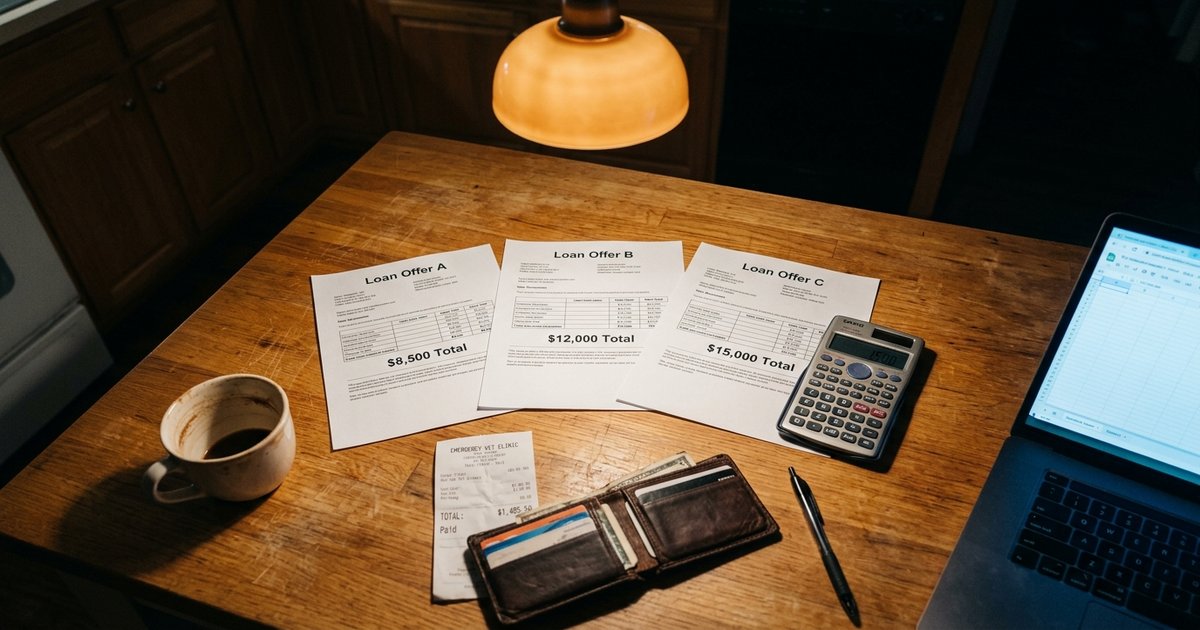
Picture this: it's a Thursday night, your dog just ate something he shouldn't have, and the emergency vet wants $1,500 before Saturday. You have $400 in checking. Rent's due in nine days. You sit at the kitchen table with three browser tabs open, a payday lender, your credit card's cash advance page, and a personal loan site, and every single one of them is promising they can help.
So which one actually does?
That's the question I want to answer here, and I want to answer it in dollars, not in lectures. Forget the "payday loans have 391% APR" headline for a second. APR is useful when you're comparing two products with the same payback period, and these three products are nothing alike. What matters when you're staring down a real bill is simpler: if I borrow $1,500, how much do I send back, and when does it end?
The decision in one paragraph
For a $1,500 borrow, a personal loan almost always costs you the least and stretches the payments the longest. A credit card cash advance lands in the middle, expensive but flexible. A payday loan is the priciest by a wide margin and is built around a two-week payoff almost nobody actually hits. The catch is access: not every borrower qualifies for every product. If you only have hours rather than days, our emergency loan decision tree sorts your options by deadline.
The three products, in plain English
A personal loan is an installment loan from a bank, credit union, or online lender. You borrow a lump sum, pay it back in fixed monthly chunks over 12 to 84 months, and the rate (APR) is set up front. The Consumer Financial Protection Bureau (CFPB) requires lenders to disclose the APR before you sign.
A payday loan is a small, short-term loan (usually $100 to $1,500) you agree to repay in full out of your next paycheck, typically in two weeks. The lender charges a flat fee per $100 borrowed instead of a traditional interest rate. The CFPB's payday loan explainer lays out the structure.
A credit card cash advance lets you pull cash off an existing credit card, either at an ATM or a bank counter. The card charges a fee at the moment you take the cash, then starts charging interest immediately, with no grace period.
$1,500 through a payday loan
The CFPB reports that the most common payday loan fee is $15 per $100 borrowed. On $1,500, that's a $225 fee due in two weeks, on top of paying back the $1,500 in full. Total owed on day 14: $1,725.
That's the version they show you on the storefront window. Now here's the part the brochure leaves off. The CFPB's own research found that more than 80% of payday loans are rolled over or renewed within 14 days, and the typical payday borrower spends about 199 days a year (roughly 55%) carrying payday debt. More than 60% of payday loans are part of a sequence of seven or more loans in a row.
What does that look like in dollars? If you can't pay the $1,725 on day 14, you "roll" the loan, meaning you pay another $225 fee and push the due date out two more weeks. If you roll it four times (eight weeks of fees), you've paid $1,125 in fees and you still owe the original $1,500. You haven't touched the principal.
One more thing to know: payday lending is regulated state by state. New York, New Jersey, Pennsylvania, Massachusetts, Georgia, North Carolina, Connecticut, Vermont, West Virginia, Maryland, Arkansas, Arizona, and DC effectively rate-cap or ban payday lenders out of the market. Texas, Missouri, Nevada, Utah, and Idaho have very few caps. Where you live changes whether this product is even on the table. Our state rate caps explainer maps the strict and permissive states.
$1,500 through a credit card cash advance
Cash advances have three costs stacked on top of each other, and most people only notice the first one.
The first cost is the cash advance fee. This is typically 3% to 5% of the amount or $10, whichever is greater, with about 4% being a common figure. On $1,500, a 4% fee equals $60 charged to your balance the moment you take the cash.
The second cost is the cash advance APR. This rate is almost always higher than your purchase APR, often 25% to 30%. And unlike purchases, there's no grace period. Interest starts the day you withdraw.
The third cost is what happens to your minimum payments. If you carry a regular balance on the card, your payments often go to the lower-rate purchase balance first, while the cash advance debt sits there compounding.
Let's run the math. Say you take a $1,500 cash advance at a 4% fee and 28% APR, then pay it off over 12 months on a declining balance. Fee at withdrawal: $60. Interest accrued over the year: roughly $231. Total cost on top of the $1,500 principal: about $291.
Not great. But notice something: that's already meaningfully cheaper than rolling a payday loan even twice.
$1,500 through a personal loan
Personal loans price you based on your credit profile, so let's run two versions. Both assume a 24-month term, fixed payment, no origination fee, and the rates I'm using come from Bankrate's April 2026 averages and Credible's bad-credit lender data.
Scenario A, prime borrower (FICO 720+), 12% APR:
- Monthly payment: about $70.61
- Total repaid over 24 months: about $1,694.74
- Total interest: about $194.74
Scenario B, near-prime borrower (FICO mid-600s), 24% APR:
- Monthly payment: about $79.32
- Total repaid over 24 months: about $1,903.68
- Total interest: about $403.68
Even at 24%, which is a steep rate, the near-prime borrower pays less in two years on a personal loan than a payday borrower pays in two months of rolling. And the prime borrower's $194 in total interest is a fraction of what a single payday loan rollover would have cost.
What if your credit is below 580? Most fintech bad-credit lenders cap APRs at 35.99%. At 35.99% over 24 months on $1,500, you'd pay roughly $89 a month, about $2,140 total, with around $640 in interest. Still less than rolling a payday loan three times. (For the dollar gap between credit tiers on a bigger loan, see what a 580 FICO actually costs vs a 680 on a $15,000 loan.)
The side-by-side, on $1,500
- Payday loan, paid in 14 days: $225 in fees, $1,725 total.
- Payday loan, rolled 4 times: $1,125 in fees, principal still owed.
- Cash advance, paid over 12 months at 28% APR: ~$291 in fees and interest, $1,791 total.
- Personal loan, prime credit, 24 months at 12%: ~$195 in interest, $1,695 total.
- Personal loan, near-prime, 24 months at 24%: ~$404 in interest, $1,904 total.
- Personal loan, sub-580, 24 months at 35.99%: ~$640 in interest, $2,140 total.
"But I need it in 36 hours"
This used to be the trump card payday lenders held: speed. That argument is weaker than it used to be.
Most major online personal loan platforms now fund same-day or next-business-day after you accept the offer. Cash advances are the fastest, you can walk to an ATM right now. Payday storefronts can fund in an hour. Personal loans typically take 24 to 48 hours from approval to deposit.
If your need is genuinely 36 hours away, a personal loan is usually still in range. If it's six hours away, it probably isn't.
The credit union option people forget
If your credit is rough and you're being quoted brutal rates everywhere else, look at your local federal credit union. Federal credit unions cap personal loan APRs at 18%, and the National Credit Union Administration (NCUA) runs a program called the Payday Alternative Loan, or PAL, with APR capped at 28% on small-dollar short-term loans. The NCUA's consumer site has details and a credit union locator. You usually need to be a member for at least a month before you can apply. If you're in a town with a sizable credit union and you're considering a payday loan, it's worth a 20-minute phone call before you sign anything.
When each product is actually the right call
I'm not going to tell you payday loans are always wrong. For a borrower with a 540 FICO living in a payday-friendly state, who needs cash by tomorrow morning, and who knows with certainty they can pay it off from one specific upcoming paycheck, a payday loan can solve the problem. The trap isn't the product, it's the rollover. If you can't repay on day 14, the math goes sideways fast.
A cash advance is the right call when you have an existing card with available limit, a clear plan to pay it off in three months or less, and no other access to credit. The fee plus accrued interest is real, but it's bounded.
A personal loan is the right call when you have a few days of runway, your credit is good enough to qualify (most lenders want 580+ for a baseline product), and the amount you need is bigger than your next paycheck.
One last thing. Trust Point Loans isn't a lender. We connect borrowers with funding options, but we don't set rates or write checks. Always confirm the actual APR, fee, and total of payments on a lender's official disclosure (the Truth in Lending Act, or TILA, requires this) before you sign. Our piece on how to read a personal loan disclosure box walks the document line by line.
Frequently Asked Questions
Is a personal loan always cheaper than a payday loan?
Almost always, on a $1,500 borrow. The personal loan stretches payments over months and charges a fixed APR. The payday loan charges a flat fee that's manageable if you pay in 14 days but gets very expensive fast if you roll it. The CFPB has documented that more than 80% of payday loans get rolled or renewed within two weeks.
Will a payday loan help build my credit?
Most payday lenders don't report on-time payments to the major credit bureaus, which means paying one off won't help your score. They will, however, send unpaid debts to collections, and collections do hit your credit.
How fast can I actually get a personal loan funded?
At many online lenders, same-day or next-business-day after you accept the offer. Some banks and credit unions take a few business days. If timing is tight, ask the lender directly before you accept.
Does a credit card cash advance hurt my credit?
Taking the advance itself doesn't trigger a hard credit pull, since you're using existing credit. What can hurt your score is the higher utilization. If a $1,500 advance pushes your card from 30% utilized to 80% utilized, your score will likely drop until you pay it down.
What's a Payday Alternative Loan (PAL)?
It's a small-dollar short-term loan offered by federal credit unions, regulated by the NCUA, with the APR capped at 28%. You typically need to have been a credit union member for at least a month.
Can I be denied a personal loan and still get a payday loan?
Often yes. Payday lenders use looser underwriting (sometimes just proof of income and a bank account), which is why they remain a fallback for borrowers who can't qualify elsewhere.